Please Choose Your Language


Views: 0 Author: Site Editor Publish Time: 2026-01-09 Origin: Site


The water heating landscape is undergoing a massive shift. As regulations tighten around fossil fuels and standard electric heaters, heat pump technology has emerged as the standard for efficiency. However, traditional refrigerant-based systems often struggle when winter temperatures plummet. They lose capacity, rely on expensive electric backup elements, and struggle to produce the high water temperatures needed for sanitation or commercial use. This performance gap has paved the way for the next generation of thermal technology: the CO2 heat pump.
A CO2 Heat Pump uses R-744 (carbon dioxide) as a refrigerant instead of synthetic chemicals. This allows the system to produce hot water up to 194°F (90°C), even when the air outside is freezing. While the upfront investment is higher than standard electric or gas systems, the efficiency gains in cold climates are substantial. This guide helps you calculate if that premium is worth it for your specific residential or commercial needs. We will cover technical differences, installation realities, and financial returns.
Cold Climate Dominance: Unlike standard heat pumps that rely on backup resistors below 40°F, CO2 systems maintain high efficiency (COP) down to -20°F.
Environmental Future-Proofing: Uses R-744 refrigerant (GWP = 1), exempt from future refrigerant phase-outs and regulatory bans affecting HFCs.
Application Specifics: Ideal for high-demand scenarios requiring rapid recovery, from luxury homes to large-scale enterprise centralized hot water supply.
Form Factor: Primarily sold as "Split Systems" (compressor outside, tank inside), eliminating indoor noise and cooling penalties.
To understand the price difference, you must understand the engine under the hood. Standard heat pumps operate like a refrigerator in reverse. They use synthetic refrigerants (like R-410A or R-134a) in a vapor compression cycle. They are efficient in mild weather but struggle to lift water temperatures significantly in a single pass.
CO2 systems utilize a "transcritical" cycle. Because carbon dioxide has a low critical temperature (87.8°F), it does not condense back into a liquid at the high-pressure side of the system during normal operation. Instead, it exists as a supercritical fluid—a dense gas with high heat capacity. This allows the heat exchanger (gas cooler) to release heat over a wide temperature glide.
This technical difference delivers a massive practical benefit: single-pass heating. Cold water from the bottom of your tank enters the heat exchanger and returns to the top of the tank at 150°F to 170°F immediately. You do not need to cycle the water multiple times to get it hot.
Refrigerant regulations are tightening globally. Standard HFC refrigerants have a high Global Warming Potential (GWP). For instance, R-410A has a GWP of over 2,000, meaning it is 2,000 times more potent than carbon dioxide as a greenhouse gas. R-744 (CO2) has a GWP of exactly 1. It is the baseline.
This makes CO2 units future-proof. You do not need to worry about future bans on HFC production or servicing limitations. For organizations with strict ESG (Environmental, Social, and Governance) goals, this is often the deciding factor.
The most tangible difference for a buyer is winter performance. Standard hybrid water heaters have a "hybrid" mode for a reason. When the air temperature drops below 40°F, or demand spikes, they activate a resistive electric element. This element is expensive to run, dropping your efficiency (COP) to 1.0.
Most CO2 systems do not even have a backup element. They maintain a high Coefficient of Performance (COP) even at -20°F. They extract heat from freezing air efficiently due to the physical properties of CO2 at high pressure. This leads to significantly lower operational costs during the months you need hot water the most.
| Feature | Standard Heat Pump (HFC) | CO2 Heat Pump (R-744) |
|---|---|---|
| Refrigerant GWP | High (>1400) | Ultra-Low (1) |
| Max Output Temp | ~140°F (60°C) | ~194°F (90°C) |
| Sub-Freezing Performance | Requires Electric Backup | Maintains High Efficiency |
| Heating Method | Multi-pass (slow rise) | Single-pass (instant lift) |
While the technology is superior, it is not always the right fit for every budget or building. The application determines the ROI.
For homeowners, the form factor is the primary advantage. Most residential CO2 units are "Split Systems." The noisy compressor and fan sit outside your house, similar to a mini-split air conditioner. The storage tank sits inside your mechanical room or garage.
This architecture resolves two major complaints about standard integrated heat pump water heaters: noise and the "cold basement" effect. Standard units exhaust cold air into your home, which increases your heating load in winter. Split CO2 systems keep the cold air outside.
Modern units also feature advanced controls. A Smart Remote-Control CO₂ Heat Pump allows users to schedule heating cycles via an app. This is critical for markets with Time-of-Use (TOU) electricity rates. You can program the system to "supercharge" the tank to a high temperature when electricity is cheap (mid-day or late night) and coast through peak pricing hours without drawing power.
Ideal User Profile:
Homeowners in Climate Zones 5 and above (cold winters).
Passive House or Net-Zero projects.
Homes with mechanical rooms too small to support the air volume requirements of standard hybrids.
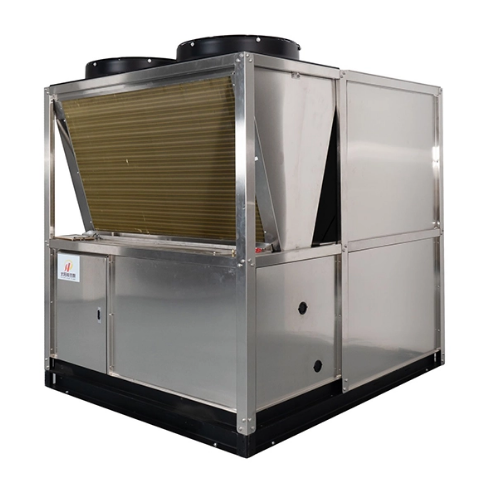
In commercial settings, the ability to generate very hot water cheaply changes the operational expenditure (OPEX) landscape. A Large-Capacity CO₂ Heat Pump is often used in hospitality and food processing. These industries require 180°F water for sanitation cycles. Standard heat pumps cannot reach these temperatures without inefficient booster heaters.
Scalability is another factor. For university dormitories or factory housing, engineers use modular banking. This involves ganging multiple units together to create a Large-scale enterprise centralized hot water supply. This modular approach provides redundancy; if one compressor needs maintenance, the others continue to serve the facility.
Case Study: Scenic Areas
Consider a remote resort or a Forest hot spring scenic area hot water supply. These locations often lack access to natural gas lines and rely on expensive propane or resistive electric heating. They also deal with cold inlet water from mountain sources.
CO2 heat pumps excel here due to the large temperature differential (Delta T). They prefer cold inlet water because it cools the CO2 gas more effectively before it loops back to the compressor, improving efficiency. Heating near-freezing mountain water to spa temperatures is the thermodynamic "sweet spot" for CO2 technology.
When shopping for these systems, marketing brochures can be misleading. You need to look at specific technical metrics to find the best unit.
Most manufacturers advertise a COP at an ambient temperature of 67°F or 70°F. While useful, this does not tell you how the machine performs in January. You must look for the performance data table. Check the COP ratings at 40°F, 17°F, and -15°F. A superior unit will maintain a COP above 2.0 even when temperatures drop well below freezing.
Since the compressor sits outside, you must consider your neighbors. Check the sound pressure level (dBA). High-end CO2 outdoor units typically run between 37 and 50 dB. This is roughly the volume of a quiet library or light rainfall. If the unit is louder than 55 dB, ensure you do not install it near a bedroom window or property line.
Recovery is measured in gallons per hour (GPH). Because of the transcritical cycle, CO2 systems often recover faster than standard heat pumps. A high recovery rate means you can potentially downsize your storage tank, saving floor space.
The tank is the passive component, but it fails first. Look for stainless steel tanks rather than glass-lined carbon steel. Glass-lined tanks rely on anode rods to prevent rust. If you forget to replace the rod, the tank leaks. Stainless steel tanks generally have longer warranties and require less maintenance, justifying the premium price of the split system.
Buying the unit is only half the battle. Installation of a split CO2 system is more complex than swapping out a standard water heater.
These are not plug-and-play appliances. They require refrigerant piping and electrical communication lines between the outdoor compressor and the indoor tank. The CO2 refrigerant operates at extremely high pressures (over 1000 psi). You must verify that your installer is certified to handle high-pressure refrigerants. A poorly brazed joint will leak, and recharging a CO2 system is specialized work.
In snow-prone regions, placement is critical. The outdoor unit must be elevated on a stand or wall bracket. It needs to sit above the regional snow line to maintain airflow. If the unit gets buried in a drift, it cannot extract heat.
Unlike integrated units, split systems avoid the "parasitic load" issue. Integrated units rob heat from your basement to heat the water, causing your furnace to work harder. Split systems harvest heat from the outside air, leaving your conditioned indoor space untouched.
Insulation is non-negotiable. Because the water lines running between the outdoor unit and indoor tank carry very hot water, any heat loss here destroys efficiency. Use high-grade insulation with a thick wall on all external piping. Furthermore, the outdoor unit will produce condensate (water) as it defrosts. You must manage this drainage so it does not create an ice slick on walkways during winter.
Is the investment justified? This depends on your local energy landscape.
Let’s be realistic: a CO2 split system can cost two to three times more than a standard electric heater and 30% to 50% more than a standard hybrid heat pump. You are paying for the durability, the cold-weather performance, and the advanced refrigerant technology.
The Return on Investment (ROI) calculation involves your local kilowatt-hour (kWh) rate versus gas or oil prices, combined with your annual heating load. In northern climates, the ROI accelerates. By eliminating the "winter efficiency dip" where standard heat pumps revert to expensive resistance heating, CO2 units save significantly more money annually than their standard counterparts in cold zones.
Financial aid is available. In the US, the Inflation Reduction Act (IRA) offers federal tax credits for heat pump water heaters. Many states and utilities offer additional electrification rebates. In commercial sectors, installing a system that complies with "Zero Emission" building codes can also unlock specific grants or green financing rates.
CO2 Heat Pumps represent the "Ferrari" of the water heating world. For a home in a mild climate with access to cheap natural gas, they may be overkill. However, for cold climates, net-zero goals, and commercial applications requiring high temperatures, they are the technically superior choice.
Final Recommendation:
Choose Residential CO2 if: You live in a region where winters routinely drop below freezing, you demand a silent indoor environment, and you want a "set and forget" system that does not spike your electric bill in January.
Choose Commercial CO2 if: You manage a facility that needs high volumes of 170°F+ water, such as a laundry facility or a spa, and you want to slash operational OPEX while meeting environmental targets.
A: Yes. High-quality CO2 heat pumps operate efficiently down to -25°F (-32°C). Unlike standard heat pumps that switch to inefficient electric resistance elements near freezing, CO2 systems utilize the unique thermal properties of R-744 refrigerant to extract heat from very cold air without needing backup heaters.
A: Generally, they are much quieter for the occupants than standard hybrid units. This is because the compressor and fan—the sources of noise—are located outside the building, similar to a mini-split air conditioner. The indoor tank is completely silent.
A: Yes. Because CO2 systems can produce high-temperature water (up to 190°F), they can effectively replace gas boilers for hydronic heating applications. Standard heat pumps often struggle to reach the temperatures required for baseboard radiators or older radiant floor loops.
A: They typically have a longer lifespan than standard hybrid units, often estimated at 15 to 20 years. This is due to higher build quality, stainless steel tanks, and reduced "short cycling" (turning on and off frequently), which reduces wear and tear on the compressor.
