Please Choose Your Language


Views: 0 Author: Site Editor Publish Time: 2025-12-29 Origin: Site


The heating and cooling industry is undergoing a seismic shift. Stringent environmental regulations and F-Gas reduction targets are forcing a transition from synthetic HFC refrigerants, like R410A and R134a, to natural alternatives such as R744 (CO2) and R290 (Propane). While "traditional" heat pumps utilizing synthetic refrigerants remain the standard for residential cooling and mild heating, CO2 heat pump technology is aggressively disrupting the market in specific high-demand sectors.
Facility managers and homeowners often struggle to navigate this technical divide. A common mistake involves choosing a system based solely on the Coefficient of Performance (COP). By focusing on this single metric, buyers frequently ignore critical factors like output temperature capabilities, climate resilience, and the vital importance of return water temperature. This oversight often leads to performance issues or missed ROI opportunities.
This guide clarifies the confusion. We argue that CO2 is not universally "better"—it is a specialized solution. You will learn why it wins decisively in high-temperature hot water generation and extreme cold climates, while traditional systems remain the superior choice for moderate space heating and cooling-heavy applications.
Best For: High-volume sanitary hot water (60°C–90°C) and district heating networks where high Delta T is possible.
The Efficiency Sweet Spot: CO2 (R744) outperforms traditional refrigerants when outside temperatures drop below -10°C, offering zero capacity loss without backup heaters.
The Critical Constraint: CO2 systems require cold return water (<30°C) to maintain efficiency; they are poor candidates for closed-loop space heating with high return temperatures.
Safety & Compliance: Unlike Propane (R290), CO2 is non-toxic and non-flammable, making it the preferred choice for dense commercial environments or strict safety codes.
ROI Reality: Higher initial CAPEX is offset by operational savings only in high-usage scenarios (e.g., hotels, dormitories, hospitals).
To understand the performance differences, we must first look at the physics inside the machine. CO2 systems are not just "greener" versions of standard heat pumps. They rely on entirely different thermodynamic cycles.
Traditional Heat Pumps (R410A/R32/R290) operate on a subcritical vapor compression cycle. The refrigerant absorbs heat, turns into a gas, gets compressed, and then condenses back into a liquid to release that heat. This process relies heavily on phase changes occurring at moderate pressures.
CO2 (R744) Heat Pumps operate on a transcritical cycle. Carbon dioxide has a very low critical temperature of 31°C. Above this point, it does not condense into a liquid. Instead, it becomes a supercritical fluid—a state where distinct gas and liquid phases do not exist. This fluid has the density of a liquid but moves like a gas.
Because the refrigerant does not condense above 31°C, CO2 systems do not use a condenser. They use a component called a gas cooler. In a traditional condenser, the temperature remains relatively constant while the gas turns to liquid. In a CO2 gas cooler, the temperature of the refrigerant glides downwards as it rejects heat.
This "temperature glide" is the secret weapon of CO2 technology. It matches the heating curve of water perfectly. As cold water (e.g., 10°C) enters the heat exchanger, it meets the cooler end of the CO2 gas. As the water warms up, it travels alongside the hotter CO2. This allows the system to heat water from 10°C to 65°C+ in a single pass with incredible efficiency.
This difference in physics dictates the application. Traditional systems are excellent at maintaining temperatures (keeping a room at 21°C). CO2 systems are excellent at lifting temperatures (taking cold water and making it very hot). Buying a CO2 unit for a load profile that doesn't match its cycle is a recipe for inefficiency.
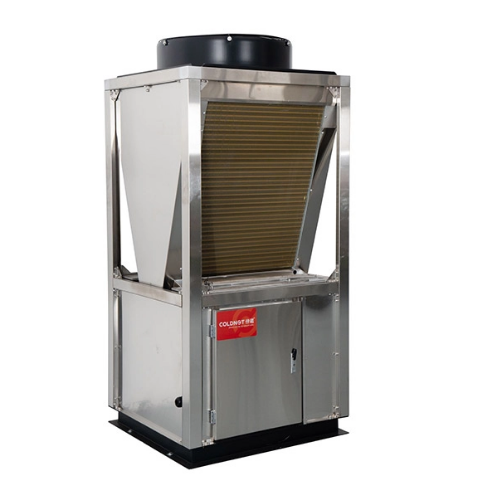
When comparing these technologies, three metrics matter most: how hot the water gets, how the system handles freezing weather, and its environmental footprint.
| Feature | Traditional (R410A/R32) | High-Efficiency CO₂ Heat Pump |
|---|---|---|
| Max Output Temp | 55°C – 60°C (requires backup heater for more) | 60°C – 90°C (Thermodynamic only) |
| Performance at -10°C | Capacity drops significantly (40-50% loss) | Minimal to zero capacity loss |
| GWP (Global Warming Potential) | High (>675 to >2000) | 1 (Ultra-low) |
| Flammability | Variable (R32 is mildly flammable) | Non-flammable (A1 Safety Class) |
Traditional refrigerants struggle as the target temperature rises. Pushing R410A or R32 to produce water above 55°C places immense strain on the compressor. Efficiency (COP) plummets, and the system often engages expensive electric resistive backup heaters to bridge the gap.
Conversely, a High-Efficiency CO₂ Heat Pump thrives in high-temperature zones. It easily achieves output temperatures between 60°C and 90°C purely via its thermodynamic cycle. This capability makes it a direct replacement for gas boilers in sanitary hot water applications where killing Legionella bacteria requires high temperatures.
Ambient temperature affects traditional refrigerants severely. As the outside air hits -10°C, a standard heat pump might lose 40% to 50% of its heating capacity. Engineers must oversize the units to compensate, which increases costs and causes "short cycling" during milder weather.
CO2 offers a distinct advantage here. Due to the high volumetric heating capacity and operating pressure of the refrigerant, these units maintain their rated output capacity even when ambient temperatures drop to -25°C. For facilities in northern climates, this reliability eliminates the need for redundant fossil fuel backup systems.
Regulatory pressure is mounting. R410A (GWP > 2000) is rapidly being phased out. While R32 (GWP 675) is a bridge solution, and R290 (Propane, GWP 3) is excellent, R290 carries flammability risks. CO2 (R744) has a GWP of 1. It is the baseline for environmental safety. It is completely future-proof against all coming environmental bans, ensuring the asset retains value without looming retrofit costs.
Despite its strengths, CO2 has a specific "kryptonite." Understanding this limitation is the most critical part of the purchasing decision. If you ignore this section, you risk installing a system that consumes electricity like a direct electric boiler.
The efficiency of the transcritical cycle depends entirely on the temperature glide in the gas cooler. For the CO2 to release its heat effectively, it must be cooled down significantly before it loops back to the expansion valve. This means the water entering the unit (return water) must be cold.
The "Death Zone" for a CO2 heat pump is a high return temperature. Consider a recirculating heating loop where water leaves at 60°C and returns at 50°C. The temperature difference (Delta T) is only 10°C.
In this scenario, the incoming water is too hot to cool the supercritical CO2 fluid. The CO2 remains at a high energy state as it enters the expansion valve, causing massive efficiency losses. If return water exceeds 30°C consistently, the COP can drop below 2.0. In contrast, traditional heat pumps handle small Delta T scenarios (like underfloor heating loops) much better.
Engineers solve this through system design. Strategies include using stratified storage tanks, which ensure the bottom layer of water remains cold (10–15°C) for the heat pump intake. Another method involves plumbing units in series or using the heat pump for the initial pre-heat stage only. Proper hydraulic design ensures the unit always receives the cold water it needs to operate efficiently.
Given the technical strengths and constraints, CO2 is not a "one size fits all" product. It dominates in specific scenarios where high temperature and high volume intersect.
This is the definitive application for CO2 technology. Consider a project like a University student dormitory daily 20 tons 60℃ hot water supply. In this setting, the usage pattern is perfect for the transcritical cycle.
The city mains water enters the building at roughly 10°C (cold). The system must heat this water to 60°C for showers and sanitation. This large temperature difference (50°C Delta T) allows the CO2 unit to operate at peak efficiency (COP > 4.0). The high volume of water usage ensures the unit runs long, stable cycles rather than turning on and off frequently. For dormitories, hotels, and gyms, CO2 eliminates the need for massive storage tanks due to its rapid recovery rate.
Older buildings often rely on radiators that require flow temperatures of 70°C or higher to warm a room effectively. Traditional heat pumps cannot reach these temperatures efficiently. CO2 heat pumps can serve as the central plant for district heating networks, provided the return water from the network is managed correctly to remain low. This allows facility managers to decarbonize heating without ripping out piping and radiators in every individual room.
Hospitals, schools, and underground shopping centers often face strict fire safety codes. While Propane (R290) is an efficient natural refrigerant, its flammability restricts its use in certain indoor or basement installations. CO2 provides a high-performance natural alternative that is non-toxic and non-flammable (Class A1), satisfying insurance requirements and safety inspectors.
Transitioning to CO2 involves financial calculations that go beyond the sticker price. The economic logic relies on operational scale and lifecycle savings.
Investors should expect to pay a premium. CO2 units typically cost 20–40% more than traditional equivalents. This cost is driven by the physical requirements of the machine. CO2 operates at extremely high pressures (up to 120 bar). Components must be manufactured from heavy-duty stainless steel, and compressors require specialized engineering to handle the stress. You are paying for industrial-grade hardware.
The operational savings can be drastic. In proper applications (like the dormitory example), CO2 units achieve a COP of 3.0 to 4.5. Compared to a gas boiler (80% efficiency) or an electric boiler (95% efficiency), the energy reduction is 300% to 400%. Furthermore, because CO2 is a natural refrigerant, it is exempt from the costly F-Gas reporting and leak check requirements that burden synthetic refrigerant systems.
The Return on Investment (ROI) depends on consumption. For a single-family home with low hot water usage, the energy savings may not cover the higher upfront cost quickly. However, for commercial facilities using tons of hot water daily, the ROI often hits within 3 to 4 years. The massive scale of energy reduction pays for the premium hardware, turning the system into a net asset for the remainder of its 15–20 year lifespan.
The debate between CO2 and traditional heat pumps is not about which is "better" in the abstract. It is about matching the machine to the thermal load.
We recommend choosing Traditional Heat Pumps (R32/R290) for residential space heating, underfloor heating applications where temperatures are low, and projects where cooling is the priority. These systems offer a lower entry cost and handle high return temperatures well.
We recommend choosing CO2 (R744) for commercial domestic hot water projects (hotels, dorms, food processing), retrofits requiring flow temperatures above 65°C, and environments where safety regulations ban flammable refrigerants. In these sectors, the ability to produce high-grade heat from cold inputs is unmatched.
Ultimately, the success of a CO2 installation depends less on the brand and more on the system design. Managing return temperatures is the key to unlocking the massive efficiency potential of this technology.
A: Yes, many CO2 units are reversible. However, their efficiency in cooling mode is generally lower than traditional R410A/R32 systems. They are best utilized in "simultaneous heating and cooling" commercial setups where the waste heat from cooling is used to generate free hot water.
A: Modern units are comparable to traditional systems (approx. 37–50 dB). However, because CO2 operates at much higher pressures, compressor sound profiles can be different (higher frequency), so vibration dampening is critical during installation.
A: Unlike low-temperature heat pumps, CO2 units can produce the high temperatures (70°C+) required by old cast-iron radiators. However, you must ensure your system design allows for low return temperatures to keep the unit efficient.
A: CO2 systems operate at pressures up to 120 bar (vs. 20–40 bar for traditional). While this sounds high, certified units are equipped with multiple safety relief valves and are manufactured with heavy-duty components. The gas itself is non-toxic and non-flammable, making it safer in the event of a leak compared to Propane (explosive) or Ammonia (toxic).


