Please Choose Your Language


Views: 0 Author: Site Editor Publish Time: 2026-01-12 Origin: Site


The global HVAC industry is undergoing a massive shift toward natural refrigerants, driven by strict ESG mandates and the accelerated phase-down of high-GWP synthetic refrigerants like HFCs. As facility managers and engineers seek sustainable alternatives, the adoption of Commercial CO₂ Heat Pumps has surged across industrial and commercial sectors. However, transitioning to R744 (CO2) technology is not merely a matter of swapping out equipment. It requires a fundamental rethinking of system design and operation.
While R744 offers superior performance for specific applications—particularly domestic hot water production—it is not a "drop-in" replacement for R410A or R32. The physics of the transcritical cycle introduce unique challenges regarding pressure management and temperature differentials. Without precise engineering, these systems can suffer from efficiency degradation and reliability issues. This article examines the technical hurdles associated with high-pressure CO2 systems and provides engineered solutions to ensure your infrastructure delivers both sustainability and operational stability.
The Delta-T Rule: CO2 systems fail efficiently without a wide temperature differential (low return water temperature is non-negotiable).
Pressure Sensitivity: Operating at 100+ bar requires distinct piping standards and safety protocols compared to standard HVAC.
Climate Resilience: Low-Temp CO₂ Heat Pumps excel in extremely cold region residential heating but require specific defrost logic.
The Skills Gap: Maintenance issues are often actually "qualified technician availability" issues.
One of the most common complaints regarding newly installed CO2 Heat Pumps is a failure to achieve the promised Coefficient of Performance (COP). In many cases, the equipment is mechanically sound, but the hydronic integration is fundamentally flawed. Unlike standard refrigerants that rely on a condensing process at a constant temperature, R744 operates in a transcritical cycle where it does not condense into a liquid but rather cools down as a supercritical gas.
In a standard heat pump, the condenser rejects heat at a stable saturation temperature. In a CO2 system, the heat exchanger acts as a "gas cooler." For the refrigerant to reject heat effectively, it must glide across a wide temperature range. Crucially, the CO2 leaving the gas cooler can only be cooled to a few degrees above the incoming water temperature.
If the return water temperature from your building loop is high (e.g., above 30°C/86°F), the CO2 cannot be subcooled sufficiently. This results in a high quality of gas entering the expansion valve, which drastically reduces the cooling effect and causes the system's efficiency to plummet. Essentially, if you feed a CO2 heat pump hot water, it cannot work efficiently.
Engineers can identify this issue by looking for specific operational symptoms:
High Electrical Consumption: The compressors run at maximum frequency, yet the thermal output remains low, leading to skyrocketing operational costs.
Temperature Misses: The system struggles to reach target output temperatures (e.g., 90°C) during peak recycle times because the return water is too warm.
Capacity Drop: The total heating capacity (kW) drops significantly as the return temperature rises.
To mitigate this, facility managers must prioritize hydronic design that guarantees a low return temperature, often referred to as a "high Delta-T" strategy.
We must redesign plumbing to ensure "single pass" heating logic rather than high-flow recirculation. In traditional boiler setups, high flow rates with small temperature drops are common. For CO2, we need the opposite: low flow rates with massive temperature lifts (e.g., entering at 10°C, leaving at 70°C). Calibrating variable speed pumps to maintain this Delta-T is critical.
Installing thermal storage tanks that effectively separate hot and cold water zones is non-negotiable. A high-quality stratification tank ensures that the water drawn from the bottom of the tank and sent back to the heat pump is at the lowest possible temperature. If turbulence inside the tank mixes the hot and cold water, the return temperature rises, and COP collapses.
For applications where return temps vary, consider using the Commercial CO₂ Heat Pump solely for pre-heating cold mains water (which is naturally low temperature). The system lifts the water from 10°C to 60°C, and auxiliary systems (like electric boilers or existing gas loops) handle the final lift if necessary. This keeps the CO2 unit in its "sweet spot" of efficiency.
| Parameter | Standard Heat Pump (HFC) | CO2 Heat Pump (R744) |
|---|---|---|
| Heat Rejection Process | Condensation (Constant Temp) | Gas Cooling (Temperature Glide) |
| Ideal Return Water Temp | Flexible (30°C - 50°C) | Strictly Low (< 30°C / 86°F) |
| Delta-T Preference | Low (5K - 10K) | High (40K - 60K) |
The defining characteristic of R744 is its immense operating pressure. While a standard R410A system might operate around 25–30 bar (360–430 psi) on the high side, a transcritical CO2 system frequently operates at pressures exceeding 100 bar (1450 psi). This extreme pressure dynamic creates maintenance challenges that do not exist in legacy HVAC systems.
The primary risk involves "standstill pressure." When a system is running, the high-side pressure is managed by the compressor and gas cooler. However, when the system stops—due to a power outage or a maintenance shutdown—the CO2 refrigerant in the liquid receiver can absorb ambient heat. Because CO2 has a low critical point (31°C), it can rapidly transition into a supercritical state inside the vessel, causing pressures to spike dangerously.
If the pressure exceeds the safety relief valve (PRV) setting, the valve will open, and the system will vent the entire refrigerant charge into the atmosphere. This is not only a financial loss but also a significant downtime event.
Repeated "Low Refrigerant" Alarms: This frequently happens after warm weekends or power failures. The system vented gas to protect itself and now cannot start.
Visual Oil Residue: Supercritical CO2 is an excellent solvent. It can dissolve standard pipe dope and sealants. If you see oil residue at pipe joints, it indicates micro-leaks caused by pressure cycling.
Managing these pressures requires robust hardware and fail-safe logic.
A standard best practice for large installations is the inclusion of "Keep-Alive" units. These are small, auxiliary cooling circuits powered by an Uninterruptible Power Supply (UPS). Their sole purpose is to cool the liquid receiver tank during power outages or standby periods, keeping the internal pressure below the venting threshold. This small investment prevents the costly loss of refrigerant charge.
Standard HVAC copper tubing is insufficient for the high-pressure side of a CO2 system. Specifications must mandate K65 copper alloy (a high-strength iron-copper alloy) or stainless steel piping. These materials can withstand the 120-bar bursts without fatigue or rupture. Using standard copper is a guaranteed recipe for catastrophic leaks.
Because CO2 is odorless, colorless, and heavier than air, a massive leak in a basement plant room poses a displacement asphyxiation risk. Strict adherence to safety codes (such as EN 378 or ASHRAE 15) is required. This involves installing active CO2 monitoring sensors connected to ventilation exhaust fans and audible alarms to protect maintenance personnel.
Mixed-use facilities present a complex thermal profile. In shopping mall centralized air conditioning, the system often faces conflicting demands: the food court requires cooling due to cooking loads, while perimeter zones and office spaces may require heating. CO2 systems excel at heating but can struggle with cooling efficiency in high ambient temperatures.
In transcritical mode (when outside air is hot), CO2 is less efficient at pure cooling compared to HFCs because the work required to compress the gas is significantly higher. If the system is asked to switch rapidly between heating and cooling, or if it tries to provide moderate cooling in 35°C+ weather without heat recovery, the control logic can become unstable. This leads to "hunting," where valves constantly open and close, trying to find a stable operating point.
Compressor Short-Cycling: The compressors turn on and off rapidly, reducing lifespan and increasing energy spikes.
Inconsistent Humidity Control: In cooling mode, if the evaporator temperature fluctuates, dehumidification becomes erratic, leading to clammy indoor environments.
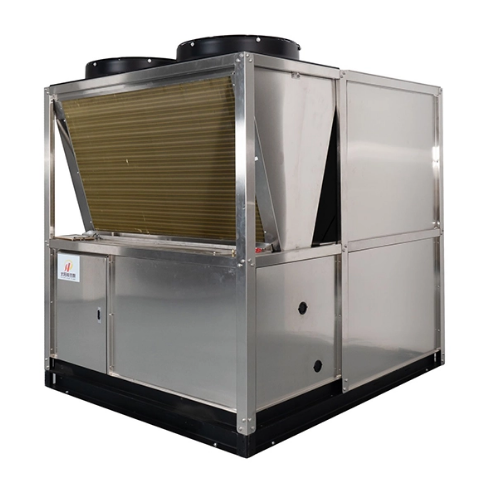
To make CO2 viable for cooling-heavy applications like malls, we must employ advanced thermodynamic strategies.
State-of-the-art CO2 systems utilize vapor ejectors. An ejector recovers energy from the expansion process (pressure drop) that is normally lost in a standard expansion valve. It uses this energy to help compress the gas, reducing the load on the main compressors. Ejectors can boost cooling efficiency (COP) by 20–30% in warm climates, making R744 competitive with traditional chillers.
Implementing parallel compression involves using a secondary compressor dedicated to handling "flash gas" from the receiver. By compressing this gas directly rather than expanding it, the system stabilizes pressure and improves efficiency during high-load cooling scenarios typical in retail environments.
The "sweet spot" for CO2 is heat recovery. In a mall, the heat rejected during the cooling of the food court should be captured to produce free sanitary hot water for restrooms and kitchens. Designing the system as a heat recovery chiller rather than a simple heat pump transforms the efficiency equation, utilizing the waste heat that would otherwise be rejected into the atmosphere.
As the market expands into colder climates, Low-Temp CO₂ Heat Pumps are being deployed for extremely cold region residential heating. While CO2 has excellent volumetric heating capacity allowing it to operate down to -20°C (-4°F), the physical management of ice on the evaporator is critical.
To extract heat from sub-zero air, the evaporator coil temperature must be significantly lower than the ambient air. This inevitably causes moisture to freeze on the fins. Because CO2 evaporators often use dense fin spacing to maximize heat transfer, "ice bridging" (where ice connects between fins, blocking airflow) happens faster than in conventional units. Traditional reverse-cycle defrosting (switching to AC mode to melt ice) places immense thermal shock on the high-pressure components, potentially shortening their lifespan.
Persistent "Steam Fog": While some steam during defrost is normal, a persistent fog that remains around the unit suggests the defrost cycle is incomplete or inefficient.
Cold Air Blowing: If the defrost logic does not properly bypass the indoor distribution, the system may blow cold air into the building while melting the outdoor ice.
Reduced Capacity: During heavy snowfall events, the unit fails to maintain output because it spends more time defrosting than heating.
Optimizing defrost logic is the key to reliability in cold climates.
Instead of fully reversing the cycle, advanced CO2 systems use a hot gas bypass method. This diverts a precise amount of hot discharge gas directly to the evaporator coil to melt the ice from the inside out. This method is gentler on the mechanical components because it avoids the drastic pressure reversals associated with 4-way valves.
We must move away from timer-based defrosting (e.g., defrost every 60 minutes). Intelligent firmware initiates defrost based on air pressure differential across the coil. The system measures the actual blockage caused by ice. If the air is dry and no ice forms, the unit keeps running. If a blizzard causes rapid icing, it defrosts sooner. This adaptive logic preserves uptime.
Physical installation matters. Units in snow-prone regions must be elevated on stands higher than the average snow depth. Additionally, installing snow hoods prevents snow from being sucked directly into the coil, reducing the rate of blockage.
Perhaps the most frustrating problem facility managers face is not mechanical, but human. The HVAC industry is currently facing a skills gap regarding natural refrigerants.
General HVAC technicians are trained on R410A and R22. When they approach a CO2 system, they often apply standard logic that is dangerous or incorrect for R744. For example, a technician might see a standing pressure that looks "low" relative to ambient temperature and assume a leak, adding refrigerant charge. In a transcritical system, this can lead to massive over-pressurization once the unit starts, causing immediate shutdowns.
Recurring Service Calls: You pay for multiple visits to fix the same error code, but the problem persists.
Manual Overrides: Technicians unable to solve the control logic issues may manually force the system into "Emergency Mode" (using electric resistance backup), bypassing the heat pump entirely. This restores heat but destroys energy savings.
To protect your asset, you must implement a strict decision framework for maintenance.
Never rely solely on a general mechanical contractor for the startup of a CO2 system. Insist on factory commissioning. The manufacturer’s engineers verify that the specialized parameters (superheat settings, gas cooler pressure curves) are calibrated correctly before the handover.
Mandate IoT connectivity. Modern CO2 heat pumps should be connected to a cloud platform that allows the manufacturer to view live pressure and temperature curves. This allows experts to diagnose "ghost" faults remotely. Often, they can identify that a valve is sticking or a sensor is drifting and guide the local technician to the exact fix before a truck is even dispatched.
CO2 heat pumps represent a robust, future-proof technology that aligns with global sustainability goals. They are capable of delivering high-temperature water at efficiencies that fossil fuel boilers cannot match. However, R744 is unforgiving of poor design. The problems discussed—efficiency losses, pressure venting, and control instability—almost always stem from ignoring the physics of the transcritical cycle.
For applications requiring high-temperature hot water, such as hotels, hospitals, and industrial processes, or for extremely cold region residential heating, the Total Cost of Ownership (TCO) justifies the complexity. However, success depends on managing the "Delta-T," respecting the high pressures, and ensuring qualified maintenance. By consulting with engineers who specialize in Transcritical R744 before procurement, you can navigate these challenges and secure a heating solution that is both powerful and environmentally responsible.
A: This is likely due to "standstill pressure" issues. When the unit stops during a power outage or warm weather, the liquid CO2 heats up and expands rapidly. If the pressure exceeds the relief valve setting (often 80-120 bar), it vents to prevent explosion. Installing a "Keep-Alive" auxiliary cooling unit on a UPS can prevent this by keeping the tank cool during downtime.
A: Yes, but with caution. CO2 systems require a low return water temperature (below 30°C) to be efficient. Standard radiators often return water at 40-50°C, which kills efficiency. You may need to upgrade to larger radiators or fan coils to ensure the water returns cold enough, or use the heat pump primarily for underfloor heating and hot water.
A: Yes. R744 has excellent volumetric heating capacity, meaning it maintains high output even at very low ambient temperatures where other refrigerants fade. As long as the defrost logic is managed correctly to handle ice buildup, CO2 is one of the best choices for cold climates.
A: The lifespan is comparable to standard commercial compressors (15-20 years) provided lubrication is managed correctly. Because of the high pressures, bearing loads are higher, so oil management is critical. Ensuring the system does not run with diluted oil (due to liquid floodback) is the key to longevity.
A: In a transcritical cycle, the refrigerant does not condense; it cools down. To maximize the cooling effect (and thus efficiency), the CO2 gas must be cooled as much as possible before the expansion valve. It can only cool down to the temperature of the incoming water. If the water enters at 40°C, the CO2 stays hot, and efficiency drops drastically.


