Introduction
Heat pumps transfer heat from low to high temperatures with minimal energy input, but their working principles and applications vary significantly due to the distinct characteristics of their heat sources: air, water, and soil. Air-source heat pumps extract heat from flowing air, water-source ones utilize stable thermal energy in water, and ground-source models rely on the constant temperature of soil—each forming a "heat acquisition logic" tailored to its source. This article explores the core differences between these three types, explaining how they efficiently harvest energy from natural sources.
1. Air-Source Heat Pumps: Flexible Heat Acquisition from Ambient Air
Air-source heat pumps (ASHPs) are the most widely used type, characterized by their convenience and adaptability. Their heat source is ubiquitous ambient air, but extracting heat from air requires addressing challenges such as temperature fluctuations and frost formation.
(1)Principle of Heat Acquisition: Capturing Scattered Air Heat
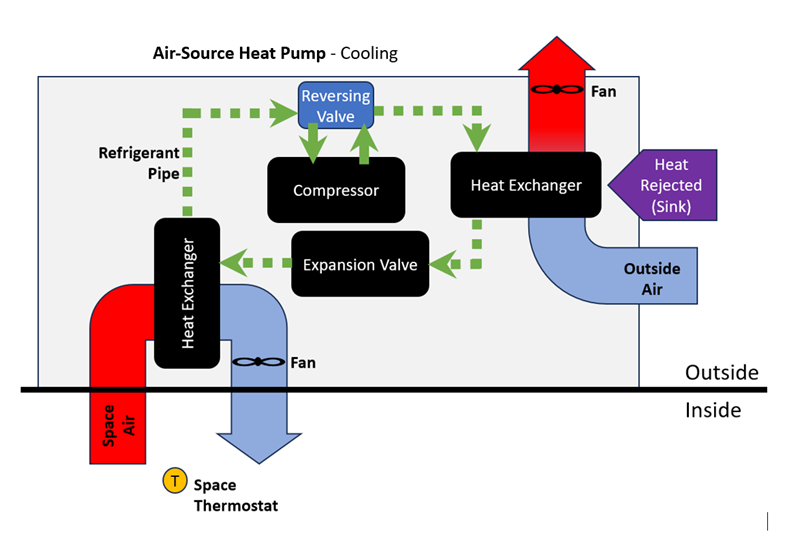
ASHPs absorb heat from the air through an evaporator equipped with finned coils. When the ambient temperature is above 0°C, the refrigerant in the evaporator (with a boiling point lower than air temperature) evaporates and absorbs heat from the air, converting it into low-temperature gaseous refrigerant. The compressor then compresses the refrigerant to high temperature and pressure, releasing heat through the condenser to heat water or air.
Even in cold weather (-10°C to 0°C), there is still usable heat in the air. Advanced ASHPs adopt "enhanced vapor injection technology": a secondary compressor injects refrigerant into the compression process, increasing the refrigerant flow rate and improving heat absorption capacity in low temperatures, ensuring stable operation.
(2)Key Challenge: Frost Prevention and Defrosting
When the evaporator temperature is lower than the air dew point, moisture in the air condenses and freezes on the fins, blocking heat exchange. Modern ASHPs solve this with "intelligent defrosting":
Sensors monitor fin temperature and running time to determine frost thickness.
When defrosting is needed, the system reverses the cycle (temporarily switching to cooling mode), using the condenser's heat to melt frost, ensuring efficient heat exchange resumes quickly.
(3)Application Scenarios: Suitable for Most Climates
ASHPs are ideal for residential, commercial, and small industrial use due to their no need for a fixed heat source (no drilling or water pipeline installation). They perform best in temperate regions (5°C to 25°C), while low-temperature models (optimized for -25°C) are suitable for cold areas.
2. Water-Source Heat Pumps: Efficient Heat Transfer Using Stable Water Temperatures
Water-source heat pumps (WSHPs) utilize thermal energy in water bodies (groundwater, rivers, lakes, or industrial wastewater). Water has a higher heat capacity and more stable temperature than air, making WSHPs more efficient but dependent on accessible water sources.
(1)Principle of Heat Acquisition: Harnessing Water’s Thermal Stability
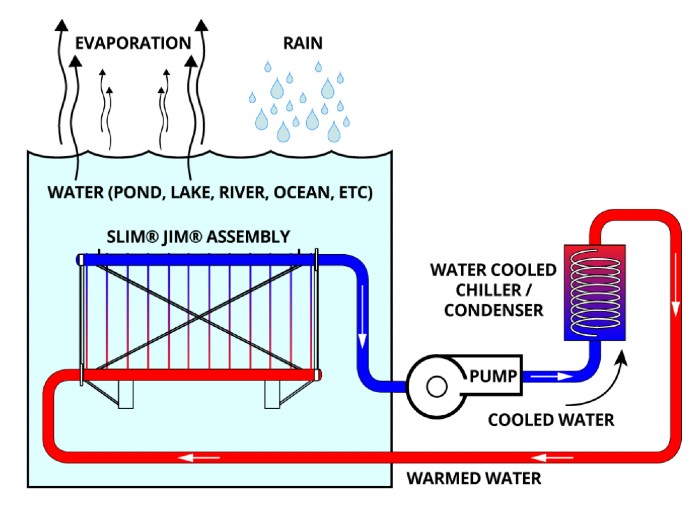
WSHPs use a closed-loop copper tube heat exchanger submerged in water. Water temperatures (typically 10°C to 20°C year-round) are more stable than air, so the evaporator can absorb heat continuously without large fluctuations.
In heating mode: Refrigerant absorbs heat from water, evaporates, and is compressed to release heat for heating.
In cooling mode: The cycle reverses, with the condenser releasing heat into the water, achieving refrigeration.
For open water sources , a filter prevents debris from blocking the heat exchanger. For groundwater systems, water is pumped from a well, passed through the heat exchanger, and reinjected into the ground to avoid depletion.
(2)Key Advantage: High Efficiency and Stable Operation
Water’s high heat conductivity (about 20 times that of air) allows WSHPs to achieve a COP (Coefficient of Performance) of 4.0 to 6.0, significantly higher than ASHPs. They are not affected by air temperature extremes, making them suitable for regions with harsh winters or summers.
(3)Application Scenarios: Dependent on Water Access
WSHPs thrive near water bodies or industrial zones with wastewater that can provide low-temperature heat. They are widely used in large buildings (hotels, hospitals) requiring stable heating and cooling.
3. Ground-Source Heat Pumps: Leveraging Soil’s Constant Temperature for Balanced Heat Transfer
Ground-source heat pumps (GSHPs), also known as geothermal heat pumps, utilize the soil’s constant temperature (10°C to 15°C at 1.5-10 meters depth) to achieve heating and cooling. The soil acts as a "thermal buffer," maintaining stable heat supply regardless of surface temperature changes.
(1)Principle of Heat Acquisition: Harnessing Soil’s Thermal Inertia
GSHPs use buried pipes (horizontal trenches or vertical boreholes) to exchange heat with the soil:
Heating mode: Refrigerant absorbs heat from the soil (via the buried pipes), evaporates, and is compressed to release heat indoors.
Cooling mode: Indoor heat is transferred to the soil through the pipes, with the soil absorbing excess heat, preventing overheating.
Soil temperature varies little throughout the year (±2°C), ensuring the system operates efficiently in all seasons. Vertical boreholes (depth 50-150 meters) are used in limited spaces, while horizontal trenches suit larger areas.
(2)Key Feature: Energy Recycling and Long-Term Stability
The soil’s large thermal capacity allows it to store excess heat in summer for winter use, creating a "thermal cycle." GSHPs have a long service life (20-50 years) with minimal maintenance, as buried pipes are protected from weathering.
(3)Application Scenarios: Ideal for Long-Term, Large-Scale Use
GSHPs are suitable for areas with stable soil conditions (no rocky layers) and long-term projects (residential communities, campuses, industrial parks).

Conclusion
Air-source, water-source, and ground-source heat pumps all follow the "heat transfer" principle but have evolved distinct strategies to adapt to their heat sources:
Air-source heat pumps prioritize flexibility, extracting heat from variable air with intelligent defrosting and low-temperature technologies.
Water-source heat pumps leverage water’s high thermal efficiency, achieving stable operation through closed-loop heat exchange with water bodies.
Ground-source heat pumps rely on soil’s constant temperature, creating a sustainable thermal cycle for long-term efficiency.
Understanding these differences helps select the right heat pump for specific climates, resources, and needs—maximizing energy efficiency while minimizing environmental impact. As technology advances, these heat pumps will continue to optimize their "heat acquisition" capabilities, driving the transition to clean energy.


