Please Choose Your Language


Views: 0 Author: Site Editor Publish Time: 2026-01-16 Origin: Site


The global HVAC and refrigeration landscape is undergoing a seismic shift driven by regulatory pressure on hydrofluorocarbons (HFCs). As refrigerants like R134a and R410a face phase-downs due to their high Global Warming Potential (GWP), the market is aggressively pivoting toward natural alternatives. Among these, R744 (CO₂) stands out not merely as an eco-friendly compliance measure, but as a thermodynamic powerhouse designed for specific, high-demand applications. For facility managers and engineers, understanding R744 goes beyond its environmental credentials; it requires grasping how its unique physical properties translate into operational efficiency.
This guide serves as a technical and commercial evaluation of CO2 Heat Pumps, focusing on water heating and specialized HVAC needs. We will move beyond the "green" marketing to analyze the physics of the transcritical cycle, the operational realities of high-pressure systems, and the Total Cost of Ownership (TCO). By examining performance data and real-world scenarios, we aim to help you determine where this technology delivers a genuine return on investment.
The "Glide" Advantage: R744’s unique transcritical cycle offers superior efficiency for high-temperature lift applications (e.g., heating cold city water to 60°C+).
Cold Climate Resilience: unlike HFCs, Low-Temp CO2 Heat Pumps maintain higher capacity retention in freezing conditions, though defrost strategies are critical.
CapEx vs. OpEx: Expect higher upfront equipment costs due to high-pressure components, balanced by future-proof compliance (GWP=1) and operational savings in the right use cases.
Best Fit: Ideal for large temperature differentials (large-scale domestic hot water) rather than low-differential space heating.
To evaluate the business utility of R744, one must first understand the science distinguishing it from traditional refrigerants. Unlike R410a, which condenses from gas to liquid at a constant temperature, CO₂ operates in a "transcritical" cycle when ambient temperatures exceed 31°C (88°F). Above this critical point, R744 does not condense; instead, it remains a dense gas that cools down gradually. This phenomenon creates a significant temperature "glide" during the heat rejection process.
The concept of "glide" is the decision-maker's most critical variable. In a standard condenser, the refrigerant stays at a fixed temperature while releasing heat. In a CO₂ gas cooler, the temperature drops smoothly across a wide range. This characteristic is a disadvantage for maintaining a constant room temperature but a massive advantage for heating water.
When cold water enters a heat exchanger at 10°C and needs to reach 60°C or higher, it creates a large temperature differential (Delta-T). The CO₂ temperature glide matches this heating curve almost perfectly. This thermodynamic alignment allows a High-Efficiency CO₂ Heat Pump to extract maximum energy from the refrigerant, resulting in a Coefficient of Performance (COP) that often outperforms traditional systems in water heating applications. This makes the technology exceptionally efficient for a Large-scale enterprise centralized hot water supply, where consistent volumes of cold inlet water are heated daily.
Beyond efficiency, R744 offers capability. Conventional heat pumps often struggle to produce water hotter than 55°C (131°F) without straining the compressor or triggering electric backup heaters. R744 systems, however, can comfortably deliver water temperatures up to 90°C (194°F).
This high-temperature output eliminates the need for resistive heating boosters in sanitation loops or specialized leisure applications. For example, a Forest hot spring scenic area hot water supply requires high thermal output to maintain pool temperatures against rapid evaporation and cold ambient air. Here, the ability of CO₂ to deliver high-grade heat ensures guest comfort without the exorbitant operational costs of electric boilers.
Critics often point to CO₂'s low critical point (31°C) as a theoretical efficiency handicap. While true that basic thermodynamic cycles suffer near the critical point, modern systems utilize advanced components like gas coolers and ejectors. Ejectors recover the energy typically lost during the expansion process, feeding it back into the system to compress the refrigerant. This engineering essentially "hacks" the physics, allowing commercial units to maintain high efficiency even when external air temperatures rise.
Facility managers in northern latitudes often dismiss heat pumps due to performance degradation in winter. R744 changes this calculus. Evidence suggests that a Low-Temp CO2 Heat Pump retains a much larger percentage of its rated capacity in freezing conditions compared to R134a or R410a alternatives.
Standard HFC refrigerants experience a steep drop in pressure and mass flow as ambient temperatures plunge, leading to a significant loss in heating capacity just when it is needed most. R744 operates at much higher pressures, which naturally keeps the vapor density high even at -20°C (-4°F).
Data from field installations shows that while an R134a unit might lose 40-50% of its capacity at -15°C, a CO₂ system might only lose 15-20%. For projects focused on Extremely cold region residential heating, this resilience is financially vital. It drastically reduces reliance on expensive resistive electric backup systems, which usually destroy the ROI of heat pump retrofits in cold climates.
However, high capacity does not grant immunity to physics. The greatest operational risk for CO₂ systems in cold climates is not the cold itself, but humidity near the freezing point (0°C to 5°C). In these "hovering" conditions, moisture in the air freezes rapidly on the outdoor coils.
A poor system design can lead to "energy vampires"—units that spend excessive time in defrost mode rather than heating. When evaluating equipment, look for units utilizing hot gas bypass or reverse cycle defrost logic. These methods clear ice quickly to minimize downtime. Smart control strategies that predict frost formation based on humidity sensors are essential for maintaining the claimed efficiency.
Aside from thermodynamics, R744 acts as a hedge against regulatory risk. R410a has a GWP of approximately 2,088. R744 has a GWP of 1. As governments impose carbon taxes and phase out HFCs, the price and availability of traditional refrigerants will become volatile. Investing in R744 removes the risk of future refrigerant taxes or scarcity pricing, effectively future-proofing the facility's asset value.
Successful implementation depends heavily on selecting the right system architecture. R744 technology is not "one size fits all," and the configuration must match the specific thermal load profile of the facility.
| Configuration | Best Application | Key Characteristic |
|---|---|---|
| Single-Stage | Dedicated Water Heating | Simplest design; requires stable low return temperatures. |
| Booster System | Supermarkets / Retail | Provides simultaneous refrigeration and heating recovery. |
| Cascade System | Industrial Process / Mixed Loads | Uses CO₂ for low stage and HFO/Ammonia for high stage. |
For most dedicated hot water applications, a Single-Stage Transcritical system is sufficient. However, for mixed-use facilities like supermarkets, Booster Systems are the standard. These allow the facility to provide refrigeration for food storage while harvesting the waste heat to warm the building or water supply.
Cascade systems offer a hybrid approach, often using CO₂ in the low-temperature stage and a different refrigerant in the high stage to manage pressure ranges. This is common in industrial settings where safety protocols for very high pressures might be stringent.
Scalability is a strong suit of R744. Modern units are modular, allowing engineers to bank multiple heat pumps together to handle loads exceeding 500kW. This modularity is crucial for applications like Shopping mall centralized air conditioning, where the load varies drastically between opening hours and night mode. A Large-Capacity CO2 Heat Pump array allows for high turndown ratios; you can run just one module during low demand and activate the full bank during peak hours, maintaining part-load efficiency.
An often-overlooked benefit is volumetric cooling capacity. Because CO₂ is a dense gas operating at high pressure, the compressors and piping diameters are significantly smaller than those required for Ammonia or HFC systems of the same capacity. This makes R744 an excellent candidate for retrofit projects in tight plant rooms where space is at a premium.
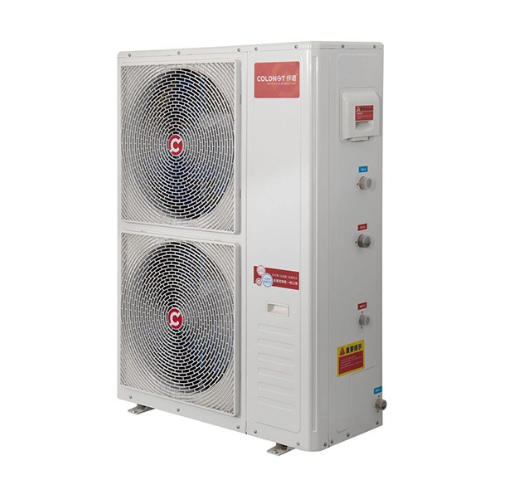
While the thermodynamic arguments are compelling, the financial and operational realities require scrutiny. R744 is not a "drop-in" replacement; it demands a shift in maintenance culture and safety protocols.
R744 operates at pressures 5 to 10 times higher than R410a, reaching up to 120 bar (1740 psi) on the high side. This pressure profile is the primary driver of Capital Expenditure (CapEx). System piping cannot use standard copper; it requires specialized stainless steel or K65 copper-iron alloy, along with robust fittings and pressure relief safeguards. Consequently, the initial equipment cost is generally higher than traditional units.
A critical operational hurdle is the skills gap. Not every HVAC technician is qualified to service transcritical CO₂ systems. The high pressures and specific control logic require specialized training. Before procurement, facility managers must verify the availability of a local service chain. Relying on a generalist technician can lead to safety risks or efficiency losses.
The complexity of the transcritical cycle means that manual tuning is virtually impossible. The efficiency of the system lives and dies by its controller. A Smart Remote-Control CO2 Heat Pump is not a luxury; it is a necessity.
Real-time monitoring of discharge pressures and the precise modulation of electronic expansion valves (EEV) are mandatory. These smart controls prevent high-pressure trips and optimize the COP by adjusting to fluctuating ambient conditions and water demand. Without intelligent control, the system may default to safe but inefficient operating modes.
When calculating ROI, the "Thermal Lift" is the deciding factor. High initial costs are offset only if the system efficiency is maximized. If an application only requires a small lift—for instance, heating underfloor loops from 30°C to 35°C—R744 will likely not have a favorable ROI compared to R32 or R290 (Propane) options. The financial win comes from the high Delta-T applications where CO₂ shines.
To assist in the "Go/No-Go" decision process, we can categorize facility profiles into ideal scenarios and those requiring caution.
The perfect scenario for a Commercial CO2 Heat Pump involves a high Delta-T. Specifically, you want cold inlet water (around 10°C) and a requirement for hot outlet water (60°C to 90°C).
A prime example is a University student dormitory daily 20 tons 60℃ hot water supply. In this setting, the water demand is high and consistent, and the inlet water is typically fresh, cold city water. This maximizes the "glide" efficiency, ensuring the unit runs at peak COP. Similarly, food processing plants or hotels requiring 80°C sanitation water are ideal candidates.
Caution is advised for systems with high return temperatures. Recirculating loops that return water at 40°C or higher can kill the efficiency of the transcritical cycle because the gas cooler cannot cool the CO₂ sufficiently. Unless sub-coolers are employed to artificially lower the return temp, the system performance will degrade.
Simple space heating retrofits are also often poor fits. Replacing old boiler radiators that need constant 70°C heat with a low temperature differential (e.g., returning at 60°C) does not leverage the strengths of R744.
Finally, safety zoning plays a role. In "public access" spaces like shopping malls or hospitals, toxic refrigerants like Ammonia or highly flammable ones like Propane (R290) often face strict restrictions. R744 is classified as A1 (non-toxic, non-flammable). This makes it the preferred high-efficiency choice for facilities where occupant safety is the paramount constraint.
R744 is not a universal replacement for every heat pump application, but it is unequivocally the superior technical solution for high-lift water heating and cold-climate performance. The shift to CO₂ represents a move toward future-proof infrastructure, insulating your facility from regulatory volatility and refrigerant scarcity.
However, successful adoption relies less on the refrigerant itself and more on the system design. Managing return temperatures and implementing smart controls are the keys to unlocking the theoretical efficiency of the transcritical cycle. Before specifying equipment, we strongly urge you to assess your facility’s specific water temperature profile. If you have high demand and cold inlet water, CO₂ is likely your most profitable path forward.
A: Yes, but primarily for applications with high hot water usage. Facilities like hotels, dormitories, and hospitals that require large volumes of hot water daily see a rapid ROI due to operational savings. For single-family homes in mild climates with low water demand, the payback period may be too long to justify the higher CapEx compared to standard residential units.
A: They can physically deliver the high temperatures (up to 90°C) that old radiators need. However, efficiency drops if the return water temperature from the radiators is high (above 40°C). They are best suited for systems where the water cools down significantly before returning to the heat pump.
A: Subcritical operation happens when the refrigerant condenses from gas to liquid, like in standard AC units. Transcritical operation occurs above the critical point (31°C for CO₂), where the refrigerant becomes a dense fluid that doesn't condense but cools down smoothly. This "glide" is what makes CO₂ so efficient for heating water.
A: Yes. R744 is rated A1, meaning it is non-toxic and non-flammable. This makes it safer than Propane (R290) or Ammonia for indoor use. However, because the system operates at high pressure, pressure safety valves must be vented properly to the outdoors to prevent CO₂ buildup in small plant rooms.
A: R744 wins on high-temperature output (up to 90°C vs. ~70°C for R290) and safety (non-flammable). R290 operates at lower pressures, which can make equipment cheaper, but its flammability restricts where and how large a system can be installed indoors. R744 is generally better for large commercial projects.


