Please Choose Your Language


Views: 0 Author: Site Editor Publish Time: 2026-07-08 Origin: Site


Increasing regulatory pressure, stringent building codes, and corporate decarbonization mandates force facility managers and engineers to phase out legacy fossil-fuel equipment. Facilities require reliable, high-temperature domestic hot water (DHW) to meet peak demand and health codes, specifically Legionella prevention. You must balance these operational necessities against capital expenditure, spatial constraints, and electrical infrastructure limits. We provide an objective, engineering-focused evaluation of traditional gas and electric boilers against modern CO2 heat pumps. This analysis determines the most viable path for commercial and multifamily centralized hot water setups. Understanding the CO2 Heat Pump vs Boiler dynamic is essential for future-proofing your building infrastructure.
Modern commercial buildings demand robust domestic hot water delivery. You must meet specific criteria to ensure safety and operational continuity. Engineers evaluate systems based on their ability to handle extreme loads while maintaining strict temperature setpoints. A failure in DHW delivery leads to immediate tenant complaints and potential health code violations.
To properly frame the challenge, facility managers should follow a structured audit process before selecting equipment:
Legacy systems rely on straightforward but inefficient heating methods. They use direct combustion of fossil fuels like natural gas or oil. Some rely on electrical resistance heating. Gas boilers typically cap at 80–95% AFUE. Electric boilers reach near 100% efficiency but carry a high operating energy penalty. These systems are simple and highly responsive to sudden demand. They remain indifferent to entering water temperatures. They are inherently limited by a 1:1 or worse energy-in to heat-out ratio. When a gas burner fires, a significant portion of the heat energy escapes through the flue stack. Condensing boilers capture some of this latent heat, but they still cannot exceed 100% efficiency.
Modern heat pumps utilize a transcritical thermodynamic cycle. They use R744 (carbon dioxide) as a natural refrigerant. This extracts ambient heat and transfers it to water. Under optimal conditions, they achieve a Coefficient of Performance (COP) of 3.0 to 4.0+. They deliver 3 to 4 units of heat for every 1 unit of electricity consumed. R744 outperforms standard HFC or HFO refrigerants for a centralized hot water heat pump system. It handles high temperature lifts without auxiliary electric backup.
CO2 heat pumps leverage a single-pass design. They heat cold water from 10°C to 65°C+ in a single pass. This maximizes thermodynamic efficiency compared to the multi-pass recirculating flow typical of boilers. In a transcritical cycle, the CO2 does not condense into a liquid while rejecting heat. Instead, it remains a supercritical fluid in the gas cooler, allowing it to glide down in temperature and transfer heat highly effectively to the cold incoming water.
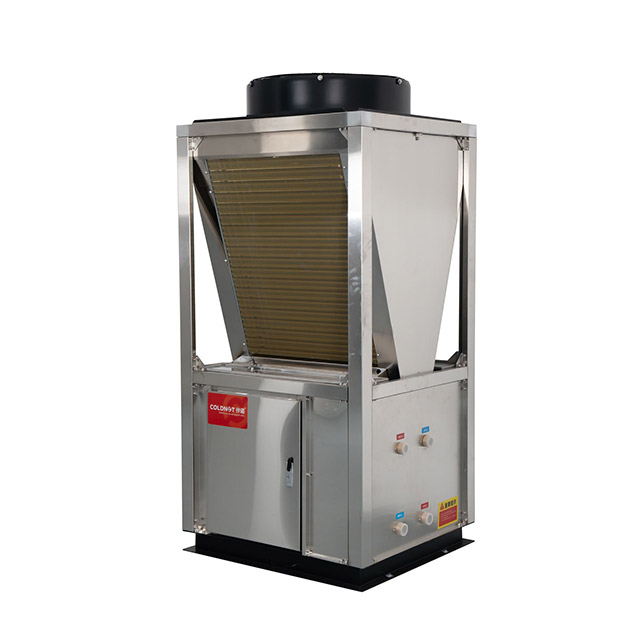
Boilers offer consistency in extreme cold. Air-source CO2 heat pumps maintain strong performance curves even at sub-zero ambient temperatures. You must account for defrost cycles and capacity derating factors during winter operation. A high-temperature CO2 heat pump requires strict temperature stratification in storage tanks. Cold water stays at the bottom, and hot water stays at the top. This maintains low gas cooler entering temperatures and high COP. If warm water enters the gas cooler, the system efficiency drops rapidly. These units can also handle dual-purpose loads. They manage DHW and hydronic space heating, such as panel radiators at 55°C (130°F).
Financial modeling highlights the operational differences. A 95% efficient gas boiler consumes more primary energy than a 300% efficient CO2 heat pump. Local utility rates impact the operational payback. The ratio of electricity-to-gas prices dictates your energy savings. Maintenance profiles also differ significantly. Boilers require routine combustion analysis, flue cleaning, and burner checks. Heat pumps require compressor monitoring, transcritical expansion valve checks, evaporator coil cleaning, and sensor calibration.
Equipment sizing plays a major role in system selection. Instantaneous and combi boilers feature a highly compact footprint. Heat pump systems necessitate large thermal storage tanks to buffer peak loads. You must evaluate structural and ventilation needs. Outdoor air-source CO2 units require adequate airflow, clearance, and structural roof load capacity. Indoor boilers require mechanical room venting, gas piping, and dedicated flues.
| Feature | Traditional Gas Boiler | CO2 Heat Pump (R744) |
|---|---|---|
| Efficiency (COP/AFUE) | 80% - 95% AFUE (COP 0.8 - 0.95) | 300% - 400%+ (COP 3.0 - 4.0+) |
| Max Output Temperature | Up to 90°C+ | Up to 90°C (194°F) |
| Footprint | Compact, minimal storage needed | Requires large thermal storage tanks |
| Emissions | High direct on-site emissions | Zero direct on-site emissions |
| Maintenance Focus | Combustion, flues, burners | Compressors, coils, sensors, valves |
Carbon accounting drives modern facility upgrades. Natural gas releases approximately 280g of carbon per kWh of heat energy. Grid-tied heat pumps produce indirect emissions that decrease over time as grids decarbonize. Upgrading mitigates risk against impending fossil fuel bans. It helps you comply with local emissions benchmarking laws like LL97 in NYC or BERDO in Boston. Facilities failing to meet these benchmarks face severe annual penalties based on their carbon footprint.
Selecting the right equipment requires strict vendor evaluation. You need a reliable boiler replacement heat pump solution. Evaluate manufacturing tolerances, transcritical compressor reliability, and safety relief valve design for high pressures. Factory-testing standards matter. Ensure the system communicates seamlessly with existing Building Management Systems. Use BACnet or Modbus for performance tracking, diagnostic alerts, and outdoor reset controls. Partnering with a proven OEM CO2 heat pump supplier ensures you receive robust technical support during installation and commissioning.
Transitioning from gas combustion to electric-driven compressors carries electrical risks. It often exceeds the capacity of existing building electrical panels and service drop lines. Conduct early-stage amp draw assessments. Utilize thermal storage to shift peak electrical loads. Explore staged compressor installations to manage power draw effectively. Upgrading a main electrical service panel requires significant lead time and coordination with local utilities.
The temperature maintenance penalty is a major design risk. Return water from the building DHW recirculation loop is often too warm. Temperatures typically range from 50°C to 55°C (122°F to 131°F). This degrades the efficiency of CO2 heat pumps if returned directly to the gas cooler. Design dedicated swing tank configurations or multi-tank systems to isolate recirculation return water. Implement a hybrid system design. Use the CO2 heat pump for primary water heating via a high-efficiency single-pass. Retain a small gas or electric boiler for temperature maintenance and extreme-cold peak backup.
High-pressure transcritical CO2 systems operate at significantly higher pressures than traditional HFC HVAC equipment. Pressures can reach 120+ bar. This requires specialized technician skills. Partner with a reputable CO2 heat pump manufacturer that provides comprehensive contractor training. Ensure they offer factory commissioning support and a guaranteed local replacement parts inventory. Technicians must use specialized gauge sets and understand the nuances of electronic expansion valves operating in supercritical states.
A: Transcritical CO2 heat pumps can produce hot water up to 90°C (194°F). This easily satisfies commercial health codes and Legionella prevention requirements without relying on auxiliary electric resistance heaters.
A: While gas boilers maintain consistent output regardless of outside temperature, CO2 heat pumps are engineered to extract heat in sub-zero conditions. They maintain strong heating capacity and high efficiency even at -20°C, though periodic defrost cycles are required.
A: The ROI timeline generally ranges from 3 to 7 years. This depends heavily on local utility rates, the spark spread between electricity and gas, and available government decarbonization incentives or rebates.
A: Heat pumps heat water more gradually than instantaneous gas boilers. Large thermal storage tanks act as a buffer to meet sudden peak demand spikes, allowing the heat pump to run continuously at optimal efficiency.
A: Yes, but careful design is required. Warm return water from recirculation loops can lower heat pump efficiency. Engineers typically use multi-tank designs or swing tanks to isolate this warm return water from the primary cold water heating cycle.
A: A single-pass design heats cold water to the target high temperature in one continuous flow through the heat exchanger. A multi-pass design recirculates water multiple times, gradually raising the temperature, which is less efficient for CO2 refrigerants.
A: CO2 systems operate at very high pressures up to 120 bar. Maintenance requires technicians trained in transcritical cycles, specialized gauge sets, and routine checks on high-pressure safety relief valves and electronic expansion valves.


