Please Choose Your Language


Views: 0 Author: Site Editor Publish Time: 2026-09-23 Origin: Site


Decarbonization mandates and volatile fossil fuel costs force plant managers to transition away from traditional gas boilers. Replacing fossil-fuel systems requires matching exact thermodynamic profiles on the factory floor. Facilities must decide whether specific processes require the phase-change energy of steam or if high-temperature pressurized water is sufficient. This choice dictates equipment selection, capital expenditure, and operational efficiency. Evaluating technical feasibility, coefficient of performance (COP), and integration realities between a water-based system and a steam-based system prevents costly specification errors. You cannot simply swap a gas burner for a compressor without analyzing the heat sink. We must look at the exact heat delivery mechanism required by the product on the line. Making the wrong choice leads to massive energy waste or failed process heating.
Thermodynamic Match is Non-Negotiable: Selecting between water and steam depends entirely on whether the process requires sensible heat (temperature change) or latent heat (phase change).
Efficiency Drops as Temperature Rises: A 120°C hot water system will inherently operate at a higher COP than a 150°C steam system due to lower compressor lift requirements.
Infrastructure Dictates Feasibility: Retrofitting industrial steam generation requires different piping, valving, and safety compliance compared to closed-loop pressurized hot water systems.
Waste Heat Quality Matters: Both systems require a reliable, continuous low-grade waste heat source (typically 40°C to 80°C) to achieve viable industrial performance.
Electrical Upgrades are Mandatory: Shifting from gas-fired boilers to megawatt-scale heat pumps requires significant electrical infrastructure planning, regardless of the output medium.
Traditional boilers provide high-grade heat regardless of actual process requirements. For decades, plants relied on centralized steam headers to deliver energy across sprawling facilities. This approach made sense when natural gas was cheap and carbon emissions were unregulated. Using 180°C steam from a central boiler to heat an 80°C washing bath represents a massive destruction of exergy. Modern industrial processes require targeted heat delivery matched precisely to the thermal load at the point of use.
The industrial high temperature heat pump has matured from a low-temp commercial concept into a heavy-duty industrial asset. These systems replace megawatt-scale gas boilers entirely. By upgrading low-grade waste heat into usable process heat, facilities drastically reduce their primary energy consumption. The technology relies on advanced compressors and specialized refrigerants designed to withstand extreme discharge temperatures without degrading over continuous operating cycles.
A successful deployment hinges on conducting a rigorous Pinch Analysis. This engineering method maps all waste heat streams against all heat sinks within a facility. It identifies the optimal temperature pinch point, ensuring the heat pump is sized for baseload efficiency rather than peak redundancy. Engineers must isolate processes that genuinely require high-grade heat from those that can operate on lower-temperature water. Downgrading the heat requirement at the point of use is the first step in any successful decarbonization project.
Executing a proper thermal integration strategy requires specific field steps:
Identify all continuous hot and cold streams across the production floor.
Extract precise thermal data, including mass flow rates, specific heat capacities, and inlet/outlet temperatures.
Construct composite curves to visualize the facility's overall heat deficit and surplus.
Locate the pinch point to determine where a heat pump can most effectively lift waste heat into usable process heat.
Size the compressor and heat exchangers to handle the baseload requirement, leaving peak loads to existing backup systems.
Hot water delivers sensible heat. When pressurized hot water interacts with a process, it transfers energy by dropping in temperature. This creates a temperature glide across the heat exchanger. Water entering a jacketed vessel at 120°C might exit at 90°C. Processes that tolerate or benefit from this wide temperature glide are highly suited for a 120°C hot water heat pump. The heat pump operates most efficiently when it receives a cooler return temperature. A lower return temperature improves the subcooling effect in the refrigerant cycle, which directly boosts the system's overall efficiency.
Engineers calculate the exact mass flow rate required to deliver the necessary kilowatts of heating power based on this temperature differential. Unlike steam, which delivers heat at a constant temperature, hot water requires careful balancing of flow rates, pump sizing, and heat exchanger surface areas. You must ensure the target process temperature is maintained without causing excessive pressure drops across the piping network.
Hot water systems handle peak demand via thermal buffer tanks. A properly sized stratified buffer tank acts as a thermal battery. It stores energy during periods of low process demand and discharges it rapidly during peak batch loads. This decoupling of heat generation from heat consumption provides a major mechanical advantage for the compressor.
It ensures a continuous supply of industrial process hot water without requiring engineers to oversize the heat pump for short-duration loads. Running a smaller compressor continuously at full load is mechanically healthier and electrically more efficient than cycling a massive compressor on and off to meet erratic batch demands. Stratification within the tank ensures the hottest water remains at the top for immediate process use, while the cooler return water settles at the bottom to feed the heat pump evaporator.
Pressurized hot water is highly versatile. It serves as the ideal medium for a vast array of manufacturing processes that historically relied on steam simply out of convenience rather than thermodynamic necessity.
Washing, rinsing, and blanching stations in food and beverage manufacturing.
Drying processes and pasteurization loops requiring precise temperature control.
District heating network feeds and large-scale space heating for factory floors.
Pre-heating boiler feedwater for legacy systems that cannot yet be fully decommissioned.
Clean-in-Place (CIP) systems where high-volume hot water is needed for sanitation.
The primary advantage of hot water generation is thermodynamic efficiency. Depending on the source temperature, these systems achieve a Coefficient of Performance (COP) between 2.5 and 3.5. For every 1 kW of electrical energy consumed, the system delivers 2.5 to 3.5 kW of thermal energy directly to the process.
Because the compressor does not need to lift the refrigerant pressure high enough to flash water into steam, the mechanical work required remains significantly lower. This lower compression ratio translates directly into reduced electrical consumption, less wear on moving parts, and a highly favorable operating expense profile. Lower discharge temperatures also extend the lifespan of the compressor oil and internal seals.
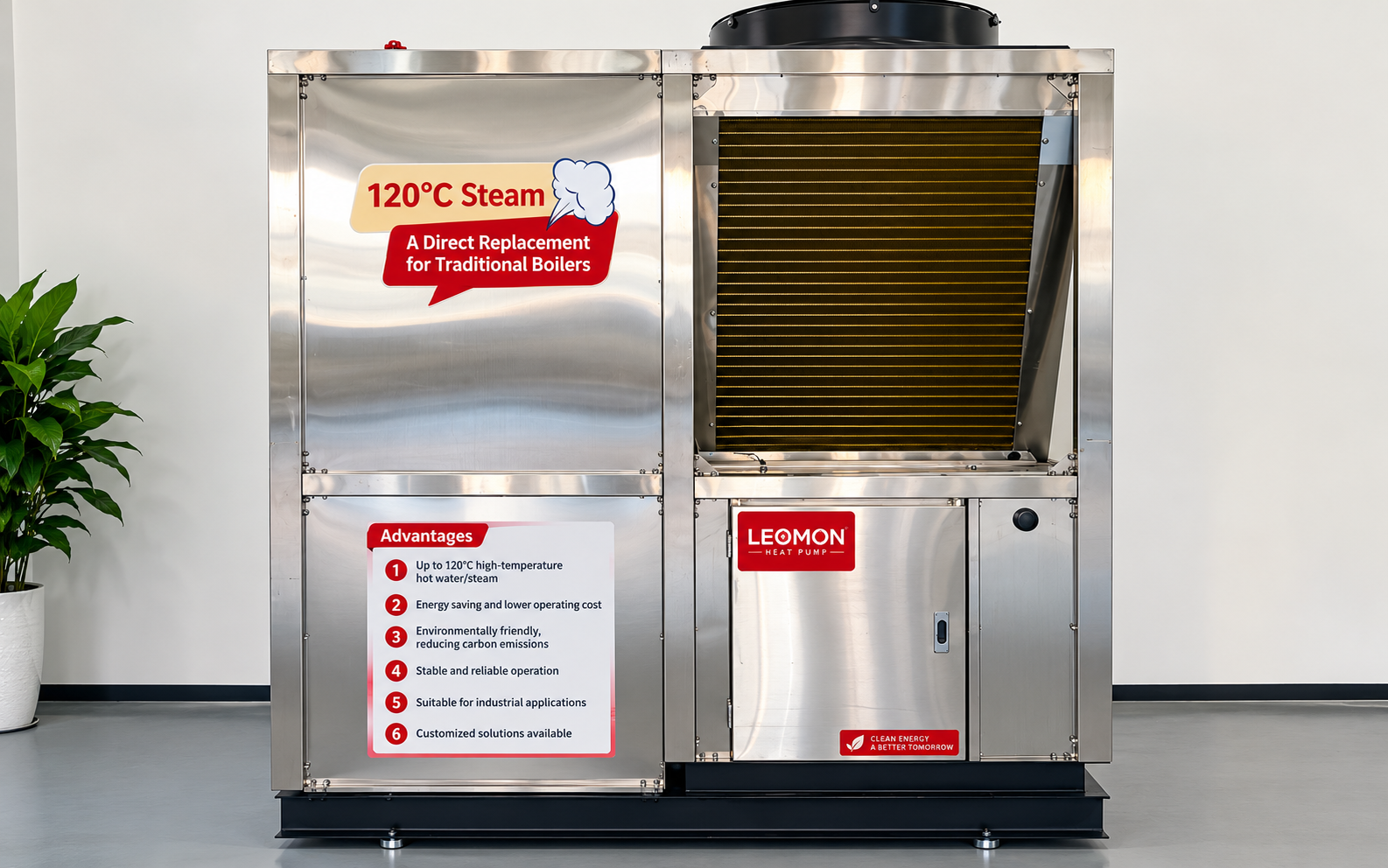
Steam delivers latent heat. This is an isothermal heat delivery process, meaning the energy transfers without a temperature drop. When 150°C steam condenses back into water on the surface of a heat exchanger, it releases a massive amount of energy while remaining at exactly 150°C. This phase change dynamic is mandatory for processes requiring rapid, uniform surface heating.
Because the temperature remains constant during condensation, steam guarantees that every part of a heating jacket or coil is exposed to the exact same temperature. This prevents cold spots and localized scorching, which is a strict quality control factor in chemical synthesis and pharmaceutical applications. You cannot achieve this level of uniform temperature distribution with a sensible heat fluid like water.
Steam provides unmatched rapid heat transfer. It meets the needs of processes requiring immediate, high-intensity heat. Because a gas occupies the entire volume of a pipe or jacket instantly, it transfers energy much faster than circulating a liquid through the same space.
This results in faster recovery times for batch processing compared to sensible water heating. When a cold batch of product enters a reactor, a 150°C steam heat pump ramps up the temperature almost instantaneously. A hot water system experiences a lag as the return water temperature drops and the circulation pumps work to catch up with the thermal load.
Certain processes strictly require the physical properties of steam. Attempting to convert these to hot water results in product failure, unacceptable cycle times, or regulatory non-compliance.
Sterilization processes that require strict thermal validation and specific holding times.
Chemical distillation columns and reactor jacket heating where uniform temperature is non-negotiable.
Paper drying rollers and corrugation processes requiring high surface temperatures.
Direct integration into existing steam networks where replacing the entire plant distribution piping is physically impossible.
Generating steam via a heat pump requires advanced engineering. It involves multi-stage compression or mechanical vapor recompression (MVR). In an MVR setup, the heat pump generates low-pressure steam, which is then mechanically compressed by a high-speed blower to raise its pressure and temperature to the required 150°C.
This high temperature lift carries an inherent energy penalty. The higher the required output temperature, the harder the compressors must work. Consequently, the COP for steam generation is lower, ranging from 1.8 to 2.5. This increases the electrical demand on the facility and requires a careful assessment of the local power grid's capacity before installation begins.
The laws of thermodynamics dictate that lifting heat to 120°C requires less energy than lifting it to 150°C. When evaluating electrical input requirements per megawatt of heat delivered, hot water systems consistently win. Over-specifying steam when 120°C water suffices destroys project viability. Plant managers must audit their end-use requirements. If a steam header is currently used solely to heat water via a shell-and-tube exchanger at the point of use, generating steam at the central plant is a massive waste of electricity.
Retrofitting a plant depends heavily on existing infrastructure. Hot water requires pressurized piping, expansion tanks, and specific pump sizing. It integrates easily into modern, decentralized plant designs where heat generation sits close to the point of use. You must account for fluid expansion and install proper air separators to keep the closed loop functioning correctly.
Conversely, industrial steam generation requires steam traps, condensate return lines, blowdown valves, and strict pressure vessel certifications. If a legacy plant is already heavily reliant on existing steam headers, dropping a steam heat pump into the existing network might be less disruptive than tearing out miles of pipe to install a new hot water loop. You must evaluate the condition of the existing steam traps and condensate pumps before connecting new equipment.
Heat pumps require a larger physical footprint than traditional gas boilers. They require large evaporators to capture waste heat and substantial compressor skids. The electrical infrastructure requirements are severe. Replacing a 5 MW gas boiler with a heat pump requires megawatt-scale electrical upgrades. Facilities will need new transformers, upgraded switchgear, and potentially new incoming high-voltage lines from the utility provider.
Upgrading the electrical infrastructure involves several mandatory phases:
Conduct a comprehensive load study to determine the facility's current peak electrical draw.
Size the new step-down transformers to handle the locked-rotor amps of the new compressors.
Install heavy-duty industrial switchgear and motor control centers (MCCs).
Route new high-amperage cabling from the MCC to the heat pump skid.
Coordinate with the local utility provider to ensure the grid can supply the additional megawatt capacity without voltage drops.
Steam heat pumps carry higher upfront capital costs due to the specialized multi-stage compressors, MVR blowers, and high-pressure refrigerants required. Hot water systems generally have lower equipment costs and offer lower operating expenses due to their higher COP. If switching to hot water requires extensive process modifications—such as replacing all the steam jackets on factory reactors—the overall project capital expenditure for the hot water route might exceed the cost of simply installing a steam heat pump.
Specification | 120°C Hot Water Heat Pump | 150°C Steam Heat Pump |
|---|---|---|
Heat Transfer Method | Sensible Heat (Temperature Glide) | Latent Heat (Isothermal Phase Change) |
Typical COP | 2.5 - 3.5 | 1.8 - 2.5 |
Infrastructure Needs | Pressurized piping, buffer tanks, circulation pumps | Steam traps, condensate lines, pressure vessels |
Ideal Applications | Washing, drying, pasteurization, pre-heating | Sterilization, distillation, rapid batch heating |
Peak Load Management | Thermal buffer tanks (Water storage) | Steam accumulators (Pressure storage) |
Compressor Technology | Single or two-stage screw/scroll compressors | Multi-stage compression or MVR blowers |
A heat pump does not create heat; it moves it. The most significant risk in any deployment is intermittent or degrading waste heat sources. If the factory process supplying the 40°C waste water shuts down, the heat pump loses its energy source and fails to deliver high-temperature output. This triggers expensive backup electric boilers and spikes the facility's peak demand charges.
To mitigate this, engineers must install thermal buffer tanks on the source side as well as the load side. Long-term data logging of waste heat streams must be conducted before specification. Do not rely on nameplate data or theoretical flow rates. Measure the actual thermal energy available over a full production cycle using ultrasonic flow meters and strapped-on RTD temperature sensors.
Treating the heat pump only as a heater misses a massive opportunity. The evaporator side of the heat pump produces chilled water as a byproduct of extracting heat. Leaving this cooling potential unutilized leaves efficiency gains on the table. You are paying to run the compressor; you should harvest both the hot and cold outputs.
Facilities should map factory cooling loads—such as HVAC requirements, machine cooling, or process chilling—to the heat pump's cold side. When a system provides both factory process heating and process cooling simultaneously, the combined Total Energy Ratio (TER) exceeds 5.0 or 6.0. This drastically improves the financial payback period and reduces the load on existing cooling towers.
Impending F-Gas regulations aggressively phase out high-Global Warming Potential (GWP) synthetic refrigerants. Specifying a system with an obsolete refrigerant creates a stranded asset that will be impossible to service in the coming years. You must look at the long-term regulatory landscape before signing a purchase order.
Mitigate this risk by specifying natural refrigerants. Ammonia (R717) and Carbon Dioxide (R744) are excellent choices for specific temperature ranges. For temperatures up to 150°C, ultra-low GWP Hydrofluoroolefins (HFOs) or specialized hydrocarbon blends are required to maintain high-temperature stability without breaking down chemically inside the compressor. Ensure the facility is equipped to handle the safety requirements of these specific refrigerants.
Purchasing commercial-grade equipment for industrial duty cycles results in premature mechanical failure. Industrial processes operate 24/7 under harsh conditions. Commercial HVAC equipment cannot withstand these rigors. The vibration, continuous load, and high discharge temperatures will destroy standard compressors within months.
Partner with a specialized high temperature heat pump manufacturer that understands industrial thermodynamics. Demand performance guarantees, transparent part-load efficiency data, and evidence of successful deployments in similar manufacturing environments. The vendor must provide detailed compressor mapping to prove the system remains stable across your specific temperature and flow rate variations.
Commission a comprehensive energy audit to log actual waste heat temperatures and flow rates over a 30-day production cycle using calibrated field instruments.
Execute a Pinch Analysis to map exact process temperature requirements and identify specific zones where steam can be permanently replaced by hot water.
Assess your facility's current electrical capacity and initiate formal discussions with the utility provider regarding megawatt-scale transformer upgrades.
Identify simultaneous cooling loads that can be tied into the heat pump evaporator to maximize the Total Energy Ratio and offset existing chiller loads.
Draft a Request for Proposal (RFP) that demands specific COP guarantees at your exact source and sink temperatures, explicitly banning commercial-grade compressors.
A: Yes, through advanced multi-stage compression or by combining a high-temperature heat pump with mechanical vapor recompression (MVR) to flash water into steam.
A: Depending on the source heat temperature, a 120°C hot water heat pump typically operates at a COP between 2.5 and 3.5.
A: It depends on the heat transfer requirement. If the process requires latent heat for rapid, uniform surface heating, steam is required. If the process tolerates a temperature drop, hot water is sufficient.
A: Replacing industrial gas boilers requires megawatt-scale electrical infrastructure. Facilities typically need upgraded transformers, new switchgear, and expanded grid connections to handle high compressor loads.
A: If installing a steam heat pump, existing steam headers and condensate lines can often be reused. If converting to hot water, new pressurized piping, circulation pumps, and thermal buffer tanks must be installed.
A: To achieve temperatures between 120°C and 150°C, manufacturers utilize natural refrigerants like Ammonia or CO2, or ultra-low GWP synthetic HFOs designed specifically for high thermal stability.


