Please Choose Your Language


Views: 122 Author: Site Editor Publish Time: 2026-09-01 Origin: Site


Commercial buildings often need more than ordinary warm water. Hotels, hospitals, laundries, food-processing facilities, schools, and apartment complexes may require continuous hot water at higher temperatures and in much larger volumes than residential properties.
A high temperature heat pump is designed for these demanding conditions. It can raise heat collected from air, water, or waste-energy sources to a temperature suitable for commercial hot water, sanitation, cleaning, and some production processes. Its suitability, however, depends on correct equipment selection and complete system design.
Commercial hot water systems must respond to changing demand while maintaining stable temperatures. The challenge is not simply heating water; it is supplying the required quantity at the right temperature without excessive energy use or interruptions.
Guest room showers and general washing may use moderate-temperature water. Commercial kitchens, hospital sanitation, and laundry operations can require hotter water.
Using one temperature for every application may waste energy. Project designers should identify which areas genuinely require high-temperature water and determine whether separate storage or temperature zones are necessary.
Hotels and hospitals may use hot water throughout the day, but their highest demand can occur during relatively short periods. Schools, dormitories, and industrial facilities may have similarly concentrated schedules.
The system must recover stored hot water before the next peak while maintaining enough reserve to prevent shortages. This makes equipment capacity, storage volume, and recovery time closely connected.
A residential water heater outage is inconvenient. A commercial hot water interruption can affect guest satisfaction, patient care, food safety, cleaning schedules, or production.
For this reason, commercial projects often need modular equipment, backup capacity, remote monitoring, and clear maintenance support. Efficiency is important, but it cannot come at the expense of reliable supply.
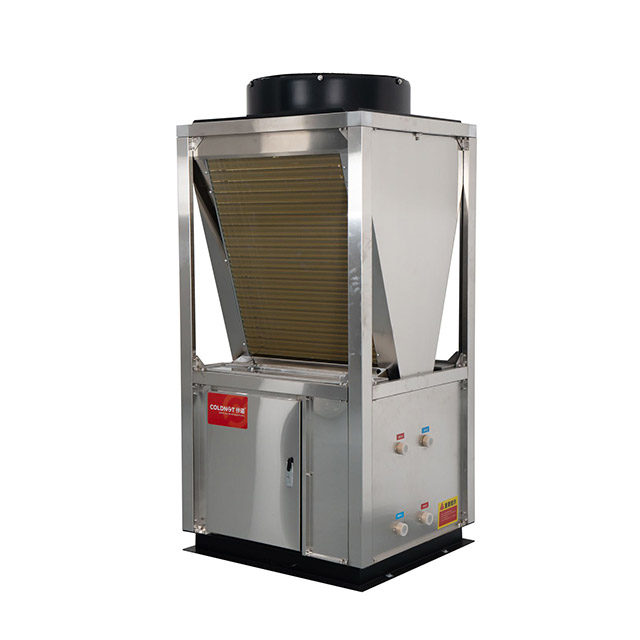
Like a conventional heat pump, a high temperature heat pump transfers heat instead of generating all its output directly from electricity. It absorbs thermal energy from the surrounding air, water, or another available heat source and raises that energy to a useful temperature.
A more detailed introduction to what a high-temperature heat pump is can help buyers understand the basic cycle. For commercial selection, the important question is how the equipment maintains capacity as the required outlet temperature rises.
Producing hotter water increases the pressure ratio and discharge temperature inside the refrigeration cycle. High-temperature systems therefore use compressors and cycle designs selected for these more demanding conditions.
Depending on the temperature requirement, the system may use enhanced vapor injection, two-stage compression, cascade operation, or a transcritical CO₂ cycle. The appropriate design depends on the heat source, target temperature, climate, and load profile.
Refrigerant selection influences operating pressure, achievable temperature, cold-weather performance, safety, and environmental impact. The heat exchanger must also transfer heat effectively while resisting water quality, temperature, and pressure conditions.
A standard heat pump should not be pushed beyond its intended temperature range. A purpose-built high temperature air source heat pump uses components and controls designed for higher output conditions.
Commercial demand changes during the day. Variable-capacity control allows the heat pump to adjust output instead of repeatedly operating at maximum capacity and shutting down.
When several units are installed as a modular system, controls can stage them according to demand. This supports more efficient part-load operation and allows remaining units to continue supplying heat if one module requires maintenance.
Their suitability comes from a combination of temperature capability, energy efficiency, load flexibility, and reduced dependence on on-site combustion.
Conventional heat pumps are often optimized for lower-temperature space heating or domestic hot water. Commercial applications may require higher temperatures for laundry, kitchen sanitation, centralized supply, or process cleaning.
High-temperature heat pumps extend the useful operating range. This makes them a possible alternative to electric heaters and boilers in applications that were previously difficult to serve with heat pump technology.
Electric resistance heaters create heat directly from purchased electricity, while boilers burn fuel. A high temperature heat pump collects part of its delivered heat from the surrounding environment or a recoverable heat source.
This can reduce the purchased energy required to produce a given amount of hot water. Actual savings depend on working conditions, energy prices, and system design, so buyers should avoid relying on one general percentage.
Facilities with regular demand allow heat pumps to operate for longer and more stable cycles. Hotels, hospitals, dormitories, and food plants can therefore be strong applications for a commercial heat pump water heater.
Storage tanks can collect hot water during lower-demand periods and release it when consumption rises. This reduces the need to size equipment for the entire instantaneous peak.
Air source and water source heat pumps do not require fuel combustion at the point of use. This removes the need for burners and combustion exhaust while reducing direct emissions at the facility.
Projects still need electrical protection, refrigerant safety, water treatment, and suitable ventilation around the equipment. The maintenance requirements change rather than disappear.
Comparison Area | Standard Heat Pump | High Temperature Heat Pump | Traditional Boiler |
|---|---|---|---|
Primary role | Moderate-temperature heating and hot water | Higher-temperature commercial and process hot water | High-temperature water or steam |
Heating method | Transfers environmental heat | Upgrades low-grade heat to a higher temperature | Burns fuel or uses direct electric heating |
Efficiency at high output temperature | May decline outside its intended range | Designed for higher temperature lift | Limited by combustion or direct conversion efficiency |
Peak-demand strategy | Usually combined with storage | Storage, modular units, or hybrid backup | Often offers rapid high-output recovery |
On-site combustion | None | None | Required for fuel-fired boilers |
Main design concerns | Climate, water temperature, sizing | Heat source, temperature lift, return water, and load | Fuel supply, exhaust, safety, and maintenance |
Best-fit applications | Homes and moderate-temperature buildings | Hotels, hospitals, laundries, campuses, and industry | Existing high-temperature systems and sharp peak loads |
The comparison does not mean a high temperature heat pump should replace every boiler. It means commercial buyers have another option when they want to reduce direct fuel use while maintaining higher water temperatures.
The strongest applications combine substantial hot water consumption with a clear need for stable temperatures.
Hotels require water for guest rooms, kitchens, spas, and laundry facilities. A high-temperature system can supply different areas through storage and temperature-control arrangements.
Commercial laundries also benefit from steady thermal demand. Heat pumps can serve the base load, while storage or backup equipment supports short peaks.
Hospitals, clinics, and senior-care facilities need dependable hot water for patient areas, kitchens, cleaning, and laundry. Redundancy and monitoring are especially important because an interruption can affect essential operations.
The proposed system should clearly explain backup operation, alarm management, and service response.
Food plants may need hot water for washing, sanitation, ingredient preparation, and equipment cleaning. Some sites can also recover heat from refrigeration systems, wastewater, or process exhaust.
Using recovered energy as the heat source can improve overall system performance, provided its temperature and availability remain predictable.
Schools, dormitories, apartment buildings, and mixed-use developments often have large but predictable hot water demand. Modular heat pumps can be installed in stages and expanded as occupancy changes.
Leomon’s heat pump application industries page provides examples of how different commercial and industrial facilities use heat pump systems.
A capable unit can still perform poorly if it is connected to an unsuitable water system.
Buyers should define daily consumption, peak demand, incoming water temperature, required outlet temperature, and allowable recovery time. Seasonal changes and future expansion should also be included.
The proposal should provide capacity at the actual operating conditions rather than only at a favorable standard condition.
Storage allows the heat pump to operate steadily and prepare for peak demand. Tank size, stratification, circulation, and return-water temperature can all influence efficiency.
Poor mixing inside a tank may send unnecessarily warm water back to the heat pump. This increases the required temperature lift and can reduce performance.
Air source equipment must be evaluated at the site’s lowest expected outdoor temperature. Water source and waste-heat systems require information about source temperature, flow, and availability.
A high rated capacity is not enough if the available capacity falls below the building load during the most demanding season.
Hard water, corrosion, and scale can reduce heat transfer. Commercial systems may require filtration, water treatment, or heat exchanger cleaning based on local conditions.
The equipment layout should provide enough space for inspection and component replacement. Maintenance access should be considered before installation, not after a fault occurs.
For large centralized hot water loads, the High Temperature CO₂ Heat Pump KRF-160IIC provides an example of a high-capacity system designed for commercial and industrial applications. It uses R744 technology and is designed to deliver hot water up to 75°C.
Its potential applications include large commercial buildings, hospital campuses, district systems, and facilities with continuous centralized demand. Final selection must still consider the required water volume, minimum ambient temperature, storage design, and available electrical supply.
Smaller commercial properties may not require this level of output. The CO₂ R744 Air Source Heat Pump KRF-60IIC represents a more compact option for moderate commercial hot water demand.
A professional high temperature heat pump supplier should provide enough information for engineers and buyers to compare proposals under the same working conditions.
Important points include:
Heating capacity at the required ambient and water temperatures
Maximum and normal operating water temperatures
Electrical input and auxiliary heating requirements
Storage and circulation recommendations
Low-temperature capacity and defrost strategy
Water quality requirements
Noise, control, and remote-monitoring functions
Certification, commissioning, warranty, and spare parts
Modular expansion and backup options
Projects with special temperature, voltage, certification, control, or installation requirements may need custom OEM and ODM heat pump solutions. These requirements should be confirmed before production and system integration begin.
High temperature heat pumps are suitable for commercial hot water applications because they combine higher outlet temperatures with heat-transfer efficiency, flexible capacity control, and the ability to reduce dependence on direct electric or fuel-fired heating.
Their performance depends on more than the heat pump itself. Accurate load calculation, storage design, return-water management, climate conditions, water quality, and control strategy determine whether the system can deliver reliable long-term savings.
Leomon Technology provides commercial, CO₂, and high-temperature heat pump systems for different building and industrial applications. Buyers planning a centralized hot water project can contact Leomon Technology to discuss operating conditions and equipment selection.
It may replace or reduce boiler use when its capacity, outlet temperature, climate performance, storage, and backup design meet the project requirements.
Buyers should specify the temperature genuinely required by each application rather than selecting the highest available temperature without a load analysis.
Yes, suitable models can operate in cold climates, but their capacity and efficiency must be checked at the site’s minimum expected temperature.


