Please Choose Your Language


Views: 142 Author: Site Editor Publish Time: 2026-06-24 Origin: Site


The commercial heating sector stands at a critical crossroads. Stringent new environmental regulations are accelerating the phase-out of traditional synthetic refrigerants. Specifying the right heating infrastructure is no longer just about meeting baseline efficiency targets. You must balance immediate technical viability against long-term regulatory compliance and operational resilience. Facility managers need systems capable of handling extreme temperatures without risking future obsolescence.
This guide strips away marketing claims to objectively compare traditional synthetic-refrigerant Air Source Heat Pumps (ASHPs) with emerging CO₂ (R744) models. We explore their system architectures, performance in extreme climates, and real-world implementation requirements. You will learn exactly how to align your next project with the optimal heating technology and navigate the complexities of modern commercial HVAC standards.
Optimal Use Cases: Traditional ASHPs remain the most cost-effective solution for low-temperature space heating (under 55°C / 130°F) in well-insulated environments. A CO₂ heat pump is purpose-built for high-temperature demands (up to 90°C / 194°F), such as commercial Domestic Hot Water (DHW), industrial processes, and retrofits with legacy radiators.
Efficiency in Extremes: CO₂ maintains higher Coefficient of Performance (COP) in sub-zero ambient temperatures without relying on backup electric resistance heating.
Compliance: CO₂ has a Global Warming Potential (GWP) of 1, effectively future-proofing investments against impending bans on synthetic refrigerants like R410A and R32.
Implementation Risk: CO₂ systems operate at significantly higher pressures, requiring specialized components, specialized installer expertise, and a higher initial Capex.
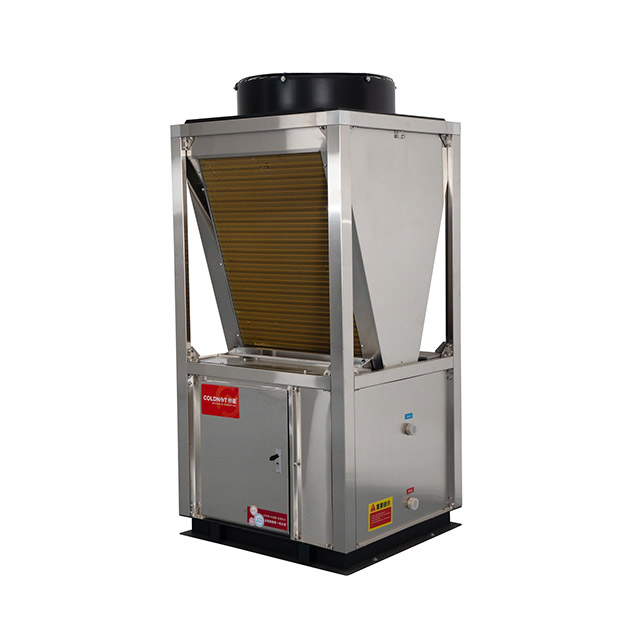
Understanding the mechanical differences between these technologies requires a look at how they handle refrigerant phase changes. Traditional ASHP mechanics operate in a subcritical cycle. They use synthetic refrigerants like R32, R410A, or R290. In these units, the phase change from liquid to gas happens at a constant temperature. This constant-temperature condensation makes subcritical systems highly efficient for low-temperature lifts. If you design a building for radiant underfloor heating at 35°C, a traditional subcritical ASHP handles this thermal load smoothly.
In contrast, a CO₂ heat pump system operates on a transcritical cycle. R744 does not condense at a constant temperature during heat rejection. Instead, it utilizes a thermodynamic property known as a "temperature glide." The refrigerant cools down gradually as it transfers heat to the water circuit.
This temperature glide makes CO₂ exceptionally efficient when there is a large temperature difference (Delta T) between the cold water entering the system and the hot water leaving it. When cold city water enters the system at 10°C, the transcritical cycle can efficiently lift it to 80°C in a single pass. A subcritical system would struggle to achieve this without multiple heating stages.
Common Mistake: Engineers often attempt to apply standard subcritical design logic to transcritical CO₂ systems. You cannot recycle warm return water back into a CO₂ gas cooler without destroying its efficiency. CO₂ systems demand the coldest possible return water to maximize the temperature glide.
System Architecture Comparison Matrix
System Attribute | Traditional ASHP (Subcritical) | CO₂ Heat Pump (Transcritical) |
|---|---|---|
Refrigerant Phase Change | Constant temperature condensation | Variable temperature glide |
Optimal Application | Low-temperature space heating | Domestic Hot Water (DHW) & Industrial |
Return Water Temperature | Flexible, accommodates warm return | Requires extremely cold return water |
Thermal Lift Capability | Standard (typically under 55°C) | High (routinely exceeds 80°C) |
Industrial processes and legacy commercial buildings push HVAC equipment to its limits. Standard ASHPs suffer severe Coefficient of Performance (COP) degradation when pushed past 55°C. Their compressors simply cannot handle the required compression ratios without risking thermal breakdown. When older buildings try to use standard ASHPs with legacy cast-iron radiators, they often rely on inefficient secondary electric boosters to make up the thermal deficit.
Facilities like hospitals, hotels, and older institutional buildings require a true high temperature air source heat pump. CO₂ uniquely achieves 80°C to 90°C output temperatures natively. It does this without relying on any secondary electric resistance heaters. This high thermal output allows facility managers to decarbonize older buildings without ripping out existing high-temperature radiator networks.
When assessing sub-zero climate resilience, the performance gap widens further. Consider how extreme cold impacts standard synthetic refrigerants:
Standard ASHP Limitations: Heating capacity drops significantly as ambient temperatures fall below -5°C. The system struggles to extract ambient heat, often triggering frequent and energy-intensive defrost cycles. These cycles reverse the heat pump to melt ice off the evaporator, actively stealing heat away from the building.
The CO₂ Advantage: R744 possesses unique thermophysical properties. It features high volumetric cooling capacity and excellent heat transfer coefficients. These properties allow CO₂ to absorb ambient heat effectively even at -20°C or lower. It maintains a stable COP and dramatically reduces winter utility spikes. Defrost cycles remain necessary, but they are shorter and have a lower impact on overall thermal delivery.
Integrating transcritical technology requires entirely different site preparation and engineering standards compared to traditional units. The most significant operational difference lies in system pressure. Standard ASHPs operate at roughly 40 bar of pressure. CO₂ systems must handle operating pressures up to 140 bar to maintain the transcritical cycle.
These extreme pressures mandate industrial-grade physical infrastructure. You cannot use standard HVAC copper piping. CO₂ installations require robust stainless steel piping or specialized heavy-duty copper alloy K65 piping. The equipment footprint often features specialized gas coolers and heavy-duty compressors engineered specifically to contain these intense internal forces. Furthermore, the system must integrate multi-stage safety relief valves and automated blow-off sequences to manage pressure spikes.
Beyond the physical hardware, facility managers must acknowledge the current technical skills gap. Servicing CO₂ systems requires specialized expertise. Standard HVAC technicians are rarely equipped or certified to handle 140-bar transcritical systems.
Best Practices for Implementation:
Verify local technician availability before specifying a CO₂ system.
Ensure the plant room has adequate ventilation to manage potential CO₂ displacement in the event of a leak.
Mandate advanced pressure testing protocols during commissioning, exceeding standard F-Gas check requirements.
The HVAC industry is navigating a web of tightening environmental mandates. The F-Gas phase-out framework is actively targeting synthetic refrigerants due to their detrimental atmospheric impacts. With tightening quotas from the EU and the US EPA, commonly used refrigerants like R410A and R134a face impending phase-outs. This regulatory pressure leads directly to future refrigerant scarcity and highly restricted supply chains.
Evaluating the Global Warming Potential (GWP) of common refrigerants illustrates why the industry is shifting toward natural alternatives. The lower the number, the less impact the gas has on global warming if released into the atmosphere.
Refrigerant GWP Comparison Chart
Refrigerant Type | Classification | Global Warming Potential (GWP) |
|---|---|---|
R410A | Synthetic HFC | ~2,088 |
R134a | Synthetic HFC | ~1,430 |
R32 | Synthetic HFC | ~675 |
Propane (R290) | Natural Hydrocarbon | ~3 |
CO₂ (R744) | Natural Gas | 1 |
Looking through a strategic decision lens, specifying CO₂ completely eliminates future regulatory retrofit risks. Because R744 has a baseline GWP of 1, it will never face phase-out legislation. This future-proofs the installation. Furthermore, deploying natural refrigerants qualifies commercial projects for stricter green building certifications, including LEED and BREEAM. Many local jurisdictions also tie decarbonization grants specifically to ultra-low GWP installations, making CO₂ an attractive compliance asset.
When scaling commercial installations or launching proprietary product lines, choosing the correct manufacturing partner is crucial. The transcritical cycle requires entirely different component engineering and advanced software controls. Not all manufacturers possess the R&D infrastructure to build safe, reliable CO₂ units. Selecting the right partner for an OEM ODM heat pump project ensures you do not inherit structural flaws.
You must evaluate potential CO₂ manufacturing partners against strict technical shortlisting criteria. Treat standard HVAC manufacturing experience as insufficient for R744 applications.
Key Shortlisting Criteria for CO₂ Partners:
Pressure Testing Protocols: Request documented burst-test tolerances. Ensure the manufacturer integrates automated safety relief valves natively into the chassis design rather than treating them as aftermarket add-ons.
Compressor Sourcing: The compressor is the heart of the transcritical cycle. Verify the utilization of industry-standard transcritical compressors from proven brands like Bitzer, Dorin, or highly vetted, industrial-grade alternatives.
Control Logic: CO₂ systems rely heavily on temperature glide management. The vendor must demonstrate proven proprietary software capable of managing the complex expansion valve algorithms unique to the R744 transcritical cycle. Poor control logic will destroy a CO₂ system's efficiency within minutes.
Specifying commercial heating equipment requires a strict alignment between building thermodynamics and system architecture. Do not specify a CO₂ heat pump if the sole objective is low-temperature space heating in a modern, well-insulated building. Standard subcritical ASHPs or R290 units handle those loads easily. However, when project parameters involve extreme climates or high-temperature output, CO₂ emerges as the superior engineering choice.
To successfully integrate these systems, follow these next-step actions. Specify CO₂ strictly for projects requiring DHW generation, industrial process heat exceeding 65°C, or installations in extreme winter climates where standard ASHP performance drops are unacceptable. Begin your engineering phase by conducting a site-specific Delta T analysis to confirm CO₂ viability. Finally, thoroughly vet your supply chain to ensure your selected hardware can safely manage transcritical pressures.
A: Yes. While operating pressures are significantly higher than traditional refrigerants, modern CO₂ systems utilize industrial-grade piping, specialized compressors, and multi-stage pressure relief valves mandated by stringent safety certifications.
A: In many cases, yes. Because CO₂ heat pumps can produce water at 70°C–80°C efficiently, they can integrate with legacy high-temperature radiator networks that would otherwise require deep retrofits if paired with standard 50°C ASHPs.
A: The transcritical cycle requires entirely different component engineering, advanced software controls to manage the temperature glide, and higher-cost materials to handle system pressure, creating a high barrier to entry for standard HVAC manufacturers.


